
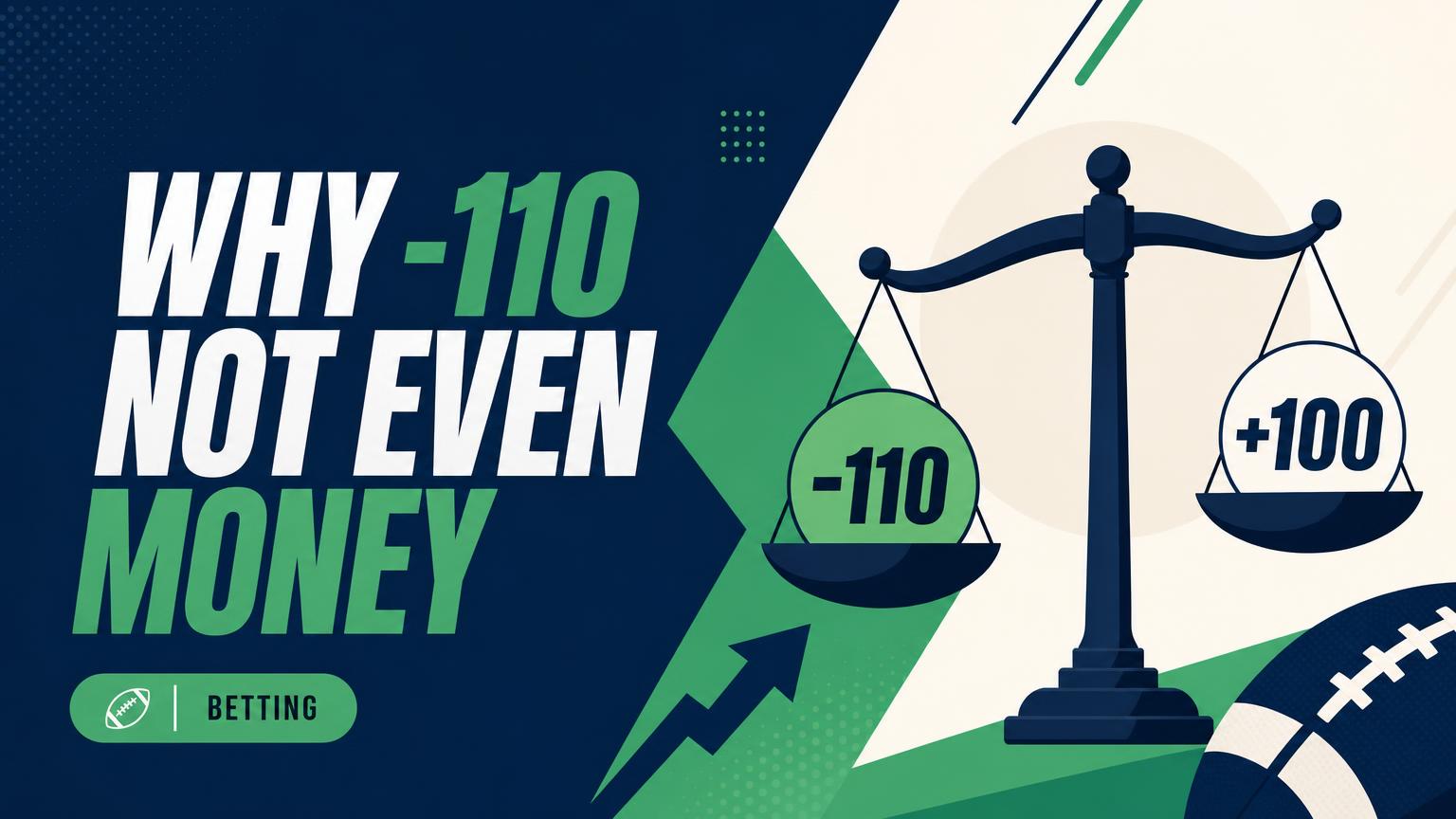
A balanced betting line does not mean an even-money wager.
A betting slip might show the favorite at -3 (-110) and the underdog at +3 (-110). The point spread makes the two sides look like 50/50 propositions, yet either wager requires $110 to earn a $100 profit.
Top Sportsbook Bonuses for October 2026

BetUS

BetNow

MyBookie

Bet105

BUSR Sports

Everygame Sports

BetOnline

BetWhale

BetAnything

Xbet

Bovada

Bookmaker
That extra $10 is the sportsbook’s vig, also called juice. In a simplified example with $110 wagered on each side, the book collects $220. It returns $210 to the winner—$110 in stake plus $100 in profit—and retains $10. Real betting action is rarely balanced that neatly, but the example shows why standard point spread odds are usually -110 rather than even money.
- At -110 odds, a bettor must win about 52.38% of wagers to break even over time.
The spread and the price do different jobs
A point spread such as Chiefs -3.5 handicaps the matchup. Kansas City must win by more than 3.5 points for that side to cash, while the underdog receives those points. This is the core mechanic covered in point spread betting for beginners.
The attached odds—typically -110—set the wager’s price. They do not give either team extra points or indicate how large the expected winning margin is. A spread can move while the price stays -110, or the sportsbook can keep the spread unchanged and adjust one side to -115 and the other to -105.
At +100 on both sides, a perfectly balanced market gives the sportsbook no theoretical betting margin. If $100 is wagered on each side, the book collects $200 and pays $200 to the winner: the original $100 stake plus $100 in profit.
At -110, equal $110 wagers produce $220 in handle, while the winning ticket returns $210. The remaining $10 is the sportsbook’s theoretical vig, assuming balanced action and no push.
What a -110 bet actually pays
At -110 odds, the bettor risks $110 to make $100 in net profit. A smaller stake works in the same proportion: divide the wager by 1.10 to calculate the potential profit.
| Stake | Net profit if it wins | Total return |
|---|---|---|
| $110 | $100.00 | $210.00 |
| $100 | $90.91 | $190.91 |
The net profit is the amount won above the original wager. The total return includes both that profit and the stake returned by the sportsbook. Therefore, a $110 winning bet does not produce $210 in profit; it produces $100 in profit, with the original $110 returned.
This distinction also explains what a $100 bet returns at -110. The sportsbook calculates the profit as:
$100 ÷ 1.10 = $90.91
Adding back the $100 stake creates a total payout of $190.91. Sportsbook bet slips often display “potential payout” or “to return,” so it is worth checking whether the figure includes the stake. If the spread bet pushes, the usual result is no profit and the original stake is refunded, although house rules should always be checked.
From implied probability to sportsbook hold
-
Convert each -110 price
For negative American odds, implied probability is 110 ÷ (110 + 100). That gives 52.38% for either side of the point spread.
-
Add both sides together
Two sides priced at -110 produce 52.38% + 52.38% = 104.76%. The amount above 100% is the overround, a key part of how sportsbook vig is calculated.
-
Identify the overround
The market’s overround is 104.76% − 100% = 4.76 percentage points. This figure comes from implied probabilities; it is not the same as saying the sportsbook keeps 4.76% of all money wagered.
-
Set up balanced action
Suppose one bettor stakes $110 on Team A and another stakes $110 on Team B. The sportsbook collects $220 in total wagers.
-
Settle the winning ticket
The winner receives $210: the original $110 stake plus $100 profit. The losing $110 stake stays with the sportsbook, leaving $10 after the $210 payout.
-
Calculate theoretical hold
The $10 remaining divided by the $220 handle equals 4.55%. The difference from the 4.76-point overround comes from the denominator: hold uses total dollars wagered, while overround uses summed implied probabilities.
The 4.55% result assumes equal $110 stakes on both sides. Real betting action is rarely perfectly balanced, and the sportsbook may take more money on the winning side than the losing side.
Actual game-by-game results can therefore be higher, lower, or negative. Theoretical hold describes the built-in pricing margin under balanced conditions—not a guaranteed profit on every event.
Why balance is not the whole business
A point spread that makes both teams appear close to 50/50 does not pay the sportsbook for taking bets. Without vig, an evenly split market at even-money odds would merely return losing stakes to winning bettors. It would provide no built-in margin for operating costs or exposure when results favor the book’s larger liability.
The familiar claim that sportsbooks want identical dollars on both sides is an oversimplification. Books often accept uneven action when the position fits their risk tolerance or their assessment of the game. What matters is the potential payout across all wagers—not just the raw amount bet on each team.
Action also carries information
A $20,000 wager from a respected bettor may influence a line more than hundreds of small public bets. Sportsbooks use that action as market information, especially when it arrives early or targets a number other books have already moved.
A book may respond by:
- moving the spread, such as from -3 to -3.5;
- changing the price, such as from -110 to -115;
- lowering limits or monitoring additional action;
- leaving the line unchanged if the liability remains acceptable.
Line movement therefore does not always mean the sportsbook is chasing equal dollars. It can reflect new information, respected action, broader market movement, or a decision to reduce risk. The spread shapes the matchup; the juice helps compensate the book for offering and managing the market.
How a sportsbook adjusts price before the spread
-
Team A opens -3 (-110)
The bettor lays $110 to win $100 while giving three points. The -110 price is a common baseline, not a required price for every point spread.
-
Demand pushes the price to -3 (-115)
The spread stays at -3, but backing Team A becomes more expensive: a $115 wager wins $100. The sportsbook can discourage additional action without changing how the game is handicapped.
-
The book protects a key number
In NFL betting, 3 is a key number because many games finish with a three-point margin. Moving from -3 to -3.5 turns a three-point win from a push into a loss, so a book may adjust the juice first.
-
The line moves to -3.5 (-105)
If pressure continues, the sportsbook may cross 3 but offer cheaper odds to offset the less favorable spread. This tradeoff also explains how alternate spread prices change betting risk.
-
Compare both parts of the quote
Team A -3 (-115) and Team A -3.5 (-105) are not interchangeable. One costs more but preserves the push on a three-point win; the other costs less but loses in that scenario.
Prices and movement vary by sportsbook, sport, market conditions and betting action.
How other prices change the equation
At -105, a bettor risks $105 to win $100. The break-even win rate is 51.22%, compared with 52.38% at -110. That smaller hurdle is why it matters whether reduced-juice spreads offer better value, especially over a large number of wagers.
Higher juice moves the hurdle in the opposite direction:
| Odds | Break-even rate | Risk to win $100 |
|---|---|---|
| -105 | 51.22% | $105 |
| -110 | 52.38% | $110 |
| -115 | 53.49% | $115 |
| -120 | 54.55% | $120 |
All else being equal, laying -120 instead of -110 requires a stronger edge. A half-point difference may justify the higher price in some situations, particularly around key NFL numbers, but cheaper odds are preferable when the spread is identical.
Alternate spreads are not merely different juice
An alternate spread changes the handicap itself. A favorite moved from -3 to -6.5 might carry plus money because covering the larger number is less likely. Moving that favorite from -3 to +1.5 could produce heavily favored odds because the bet now has more cushion.
That pricing reflects both the sportsbook’s margin and a meaningful change in expected probability. Plus money does not automatically mean value, and steep negative odds do not automatically make a wager poor. The relevant question is whether the estimated chance of covering exceeds the break-even rate implied by the offered odds.
The cost of a 50-50 record
At -110, the break-even calculation is 110 ÷ (110 + 100) = 52.38%. That means more than 52 wins per 100 settled bets are needed to cover the juice over time. Pushes do not count because the stake is returned.
Assume 100 wagers, each risking $110 to win $100:
| Record | Win profit | Losing stakes | Net result |
|---|---|---|---|
| 50-50 | $5,000 | $5,500 | -$500 |
| 52-48 | $5,200 | $5,280 | -$80 |
| 53-47 | $5,300 | $5,170 | +$130 |
The table shows why “winning half the bets” is not enough. It also shows that 52.38% is a long-run threshold, not a record that can appear exactly over 100 decisions.
Small price improvements matter
Line shopping can reduce the cost without making any pick more likely to win. At -105, the break-even rate falls to 51.22%. For 50 losses on bets risking $105 to win $100, the total loss from juice is $250 instead of $500 at -110.
That difference can compound across a season, but it is not a guaranteed betting system. Shopping several sportsbooks helps control price, while consistent unit sizing limits how much a losing streak can damage the bankroll. Neither creates an edge by itself; both reduce avoidable cost and uncontrolled variance.
-
Confirm the line and price
Check both the point spread and attached odds; -110 is common, but pricing can vary.
-
Calculate the break-even rate
At -110, a wager must win 52.38% of the time to break even over the long run.
-
Compare available prices
A better number or reduced juice can matter, provided the sportsbook is legal and reputable.
-
Set the stake before betting
Use a consistent unit tied to a predetermined bankroll limit rather than changing stakes after wins or losses.
-
Review the result calmly
Judge the decision by the information available when the wager was placed, not only by whether it won.
The extra 10 is the sportsbook’s margin
A point spread may create a near-even matchup, but -110 keeps the wager from paying even money. That pricing supplies the sportsbook’s margin and raises the bettor’s break-even rate above 50%.
Betting is entertainment, not dependable income. Set firm bankroll and wager limits, accept losses as part of the cost, and never chase them with larger bets.
Top Sportsbook Bonuses for October 2026
BetUS
BetNow
MyBookie
Bet105
BUSR Sports
Everygame Sports
BetOnline
BetWhale
BetAnything
Xbet
Bovada
