
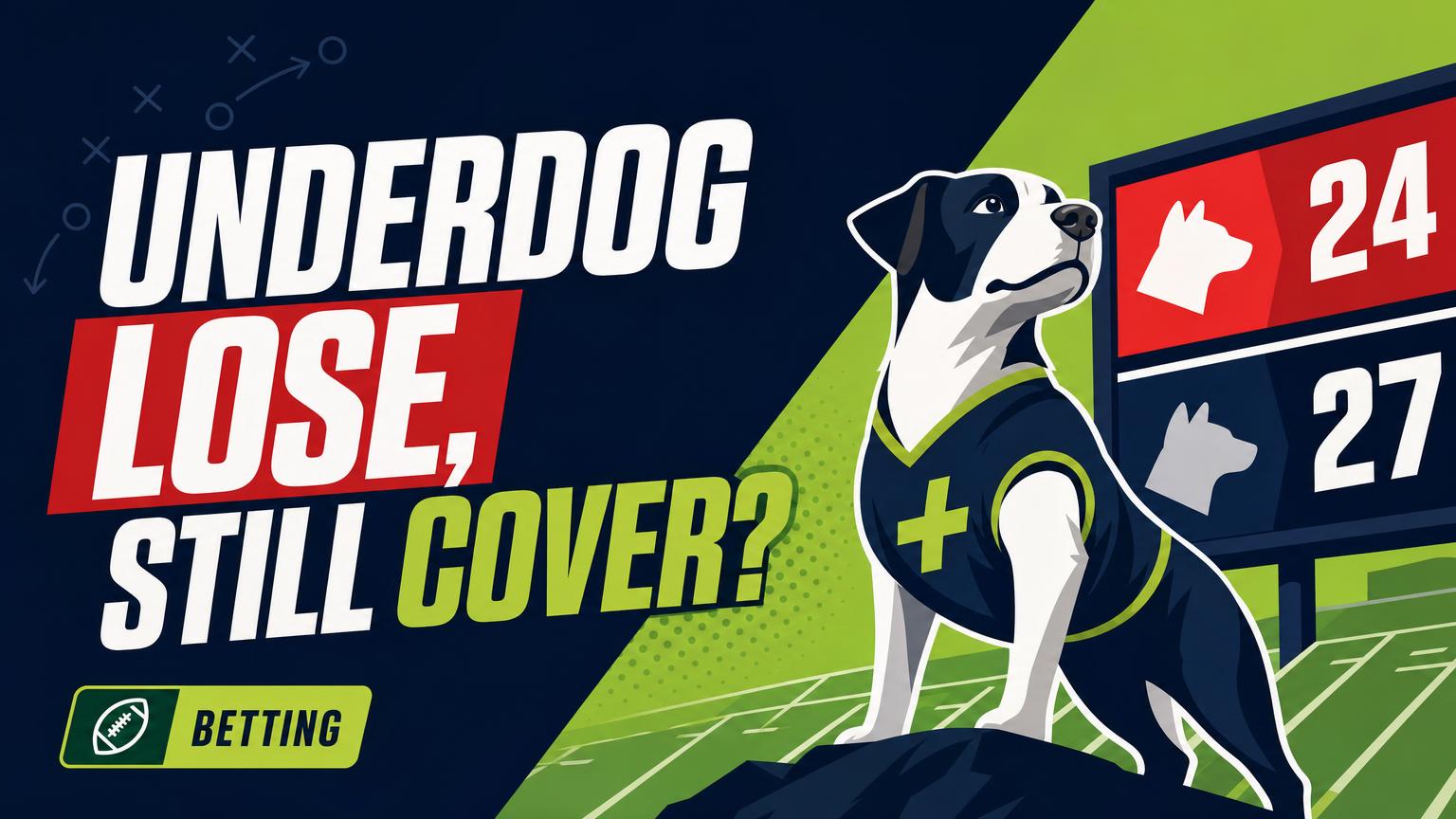
A losing team can still produce a winning point-spread ticket.
Final score: favorite 24, underdog 20. The underdog lost by four points, but a +7.5 spread wager wins because the team stayed within 7.5 points. For grading purposes, adding 7.5 to the underdog’s score creates an adjusted score of 27.5–24.
Top Sportsbook Bonuses for October 2026

BetUS

BetNow

MyBookie

Bet105

BUSR Sports

Everygame Sports

BetOnline

BetWhale

BetAnything

Xbet

Bovada

Bookmaker
That is what a +7.5 betting line means: the underdog may win outright or lose by seven points or fewer and still cover. Losing by eight or more fails to cover. Because the line includes a half-point, this wager cannot push. An underdog moneyline bet is different—it requires the team to win the game outright.
How is an underdog spread graded?
An underdog’s positive point spread is added to its final score for grading purposes. If that adjusted score exceeds the favorite’s score, the wager covers. This basic calculation is central to the fundamentals of point spread betting[/nodelink id="1"].
The same result can be found by comparing the underdog’s losing margin with the accepted spread:
- Losing by less than the spread means the underdog covers.
- Losing by more than the spread means the wager loses.
- Losing by exactly a whole-number spread creates a push, typically returning the stake.
| Bet slip | Final score | Losing margin | Grade |
|---|---|---|---|
| Underdog +6.5 | 24–20 | 4 points | Win |
| Underdog +6.5 | 27–20 | 7 points | Loss |
| Underdog +7 | 27–20 | 7 points | Push |
The sportsbook settles the wager using the line shown on the accepted bet slip. If an underdog was taken at +6.5 and the market later moves to +7.5, the original wager remains +6.5. Its accepted odds, such as -110, also remain unchanged. Separate wagers placed after a line move are graded according to their own listed spreads.
What Are the Four Possible Underdog Outcomes?
An underdog does not need to win the game to cash a point-spread wager. The result depends on the final margin compared with the accepted betting line.
Assume Chicago is a +7 underdog against Dallas:
| Game result | Chicago +7 wager | Dallas -7 wager |
|---|---|---|
| Chicago wins 24-21 | Outright win and cover. Chicago also would win on the moneyline. | Loses because Dallas lost outright. |
| Chicago loses 24-20 | Covers despite losing. The four-point loss stays inside the seven-point spread. | Fails to cover. |
| Chicago loses 27-20 | Push. Adding seven produces a 27-27 adjusted score, so the stake is generally refunded. | Also pushes because Dallas won by exactly seven. |
| Chicago loses 31-20 | Fails to cover. An 11-point loss exceeds the spread. | Covers by winning by more than seven. |
This inverse relationship is central to how favorites cover the spread: when one side covers, the other side normally fails to cover. A push is the exception, with both straight spread wagers graded as pushes.
Why the half-point matters
A whole-number line such as +7 can push because a team can lose by exactly seven. With +7.5, there is no matching whole-number scoring margin: a seven-point loss covers, while an eight-point loss does not.
That extra half-point is often called the hook. It forces a winning and losing side at that margin rather than a push. Sportsbook rules can differ for unusual settlements and parlays, so the posted house rules still control grading.
How Does an Underdog Spread Differ From an Underdog Moneyline?
A moneyline wager on an underdog wins only if that team wins the game outright. A point spread wager can cash even when the underdog loses, provided the final margin stays within the accepted spread.
Consider a hypothetical NBA game with Chicago listed at +6.5 against Boston. Boston wins 104–100, so Chicago loses the game by four points.
- Chicago +6.5: Wins. Adding 6.5 points produces an adjusted score of Chicago 106.5, Boston 104.
- Chicago moneyline: Loses. Chicago did not win outright.
If Chicago had won 101–100, both tickets would cash: the moneyline because Chicago won the game, and the spread because Chicago covered +6.5.
Underdog moneylines generally offer larger potential returns than spread bets because an outright upset is harder to achieve than staying within a point spread. For example, a sportsbook might price the spread near standard -110 juice while offering plus-money odds on the underdog moneyline. The exact price depends on the matchup and market, but the tradeoff remains the same: a higher potential payout comes with a stricter win condition.
Common Questions About Spread Settlement
Does -110 change how many points an underdog gets?
No. Odds such as -110 determine the wager’s cost and potential payout, not the covering margin. The point spread shown on the accepted ticket determines whether the bet wins, loses or pushes.
Does overtime count toward the point spread?
Usually, yes. Most full-game spread markets include overtime in the final score, but markets labeled “regulation only” or similar may exclude it, so the sportsbook’s rules should be checked.
What happens when a spread bet pushes in a parlay?
A push is commonly removed from the parlay, and the remaining legs continue at recalculated odds. If every leg pushes, the stake is typically returned, though house rules control settlement.
Can a team have a losing record but a winning ATS record?
Yes. Straight-up records track game winners, while against-the-spread records track betting-line results. That distinction explains how an ATS win is recorded even when the underdog loses the game.
Unusual markets—including alternate spreads, shortened games and regulation-only wagers—may use different grading rules. Save the accepted ticket and review the sportsbook’s published rules before disputing a settlement.
Did the underdog cover, push, or lose?
-
Find the underdog’s losing margin
Subtract the underdog’s score from the favorite’s score. This test applies when the underdog loses outright.
-
Smaller than the positive spread: cover
An underdog that loses by 4 with a +6 spread covers. The spread wager wins.
-
Equal to a whole-number spread: push
An underdog that loses by exactly 6 at +6 pushes. The original stake is generally returned.
-
Larger than the positive spread: loss
An underdog that loses by 7 at +6 fails to cover. The wager loses.
Always grade the wager against the betting line accepted on the ticket, not the closing line.
The sportsbook’s line reflects a market price designed to balance risk and attract action. It does not guarantee the favorite will win—or that the underdog will keep the game close.
The result comes down to a simple margin comparison. Even a sound read can lose, so spread bets should fit a planned bankroll. Stakes should remain consistent, and losses should never be chased with larger wagers.
Top Sportsbook Bonuses for October 2026
BetUS
BetNow
MyBookie
Bet105
BUSR Sports
Everygame Sports
BetOnline
BetWhale
BetAnything
Xbet
Bovada
