
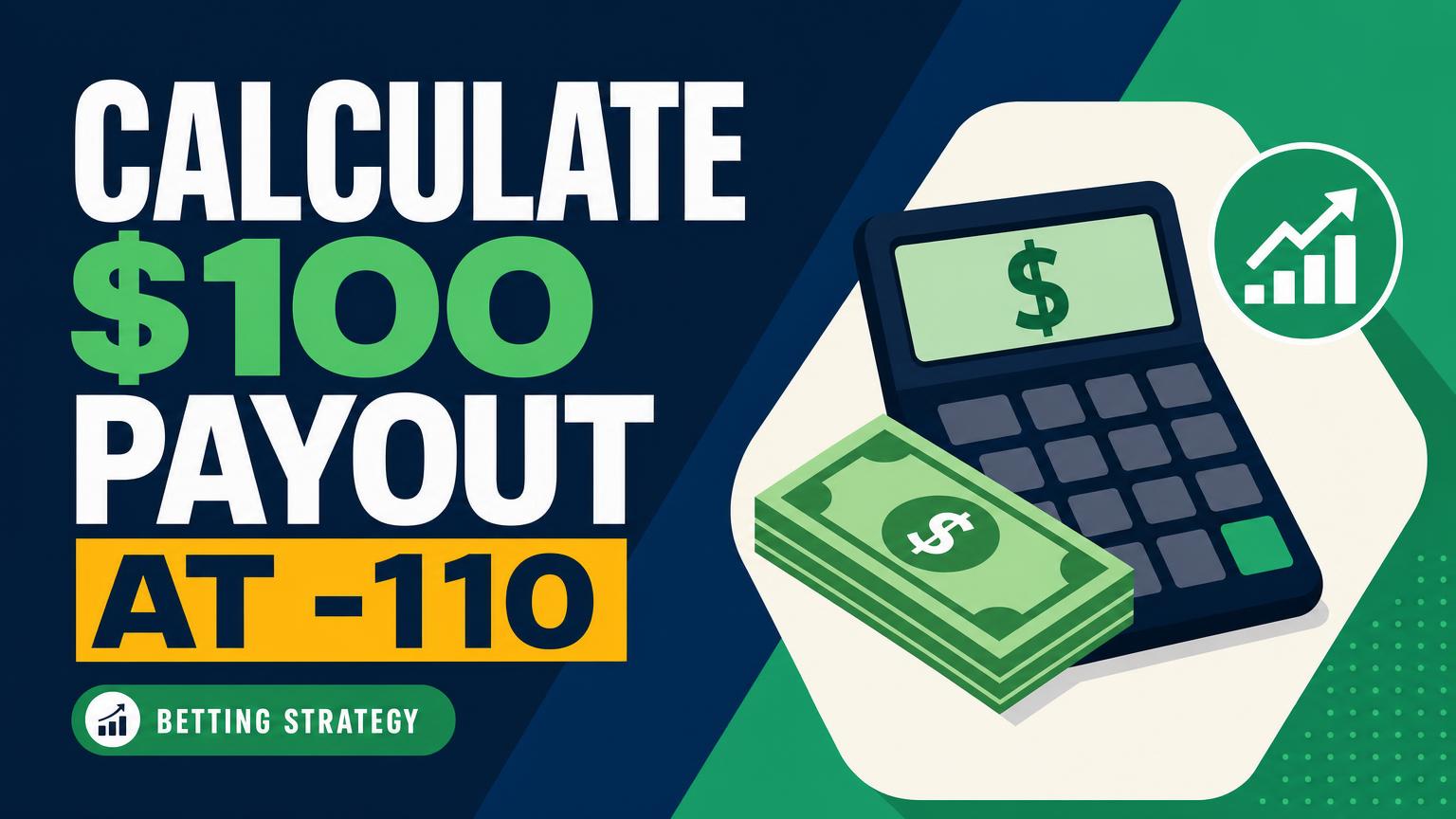
Negative odds quote the price of a wager—not a dollar-for-dollar payoff.
A sportsbook slip showing a $190.91 return on a $100 wager at -110 can look short at first glance. The number is correct: the bet earns about $90.91 in profit, and the sportsbook also returns the original $100 stake.
Top Sportsbook Bonuses for October 2026

BetUS

BetNow

MyBookie

Bet105

BUSR Sports

Everygame Sports

BetOnline

BetWhale

BetAnything

Xbet
Bovada

Bookmaker
The calculation is $100 ÷ 110 × 100 = $90.91 profit. Add the stake back, and the total payout is $190.91. A $200 return would apply to +100, or even-money, odds. To make exactly $100 in profit at -110, the bettor would need to risk $110; a win would return $210 total.
Risking $100 vs. winning $100
Sportsbook bet slips can frame the same -110 wager in two different ways. A $100 stake means $100 is at risk; a winning bet produces $90.91 in profit and $190.91 in total payout. A bet entered to win $100 requires a $110 stake and pays back $210, including the original wager.
Before submitting, check the field labels:
- Wager, risk, or stake: Money deducted from the bankroll when the bet is placed.
- To win or profit: Net earnings if the spread bet wins.
- Payout, return, or potential return: Profit plus the returned stake.
Some bet slips emphasize profit, while others display total payout. Confirming which figure appears prevents a common mistake: entering $100 in the risk field while expecting $100 in profit.
For a standard -110 line, $110 risk / $100 profit / $210 payout confirms the amounts are being read correctly.
What -110 actually means
The point spread and -110 odds do different jobs. A line such as Team A -3 sets the covering condition: Team A must win by more than three points for the bet to cash. A three-point win is generally a push, with the stake returned.
The -110 figure is the wager’s American odds price. It means $110 must be risked to make $100 in profit. Because stakes can be scaled, a $100 wager at -110 earns $90.91 in profit and returns $190.91 total if it wins.
Sportsbooks commonly price both sides of a spread near -110, building vig, or juice, into the market. That pricing convention is separate from which team covers; the reason standard spread odds often sit at -110 comes from how the sportsbook applies its margin. Odds may move to -105, -115, or another price without changing the posted spread.
Calculate the profit on a $100 bet at -110
For negative American odds, divide the stake by the odds number without the minus sign, then multiply by 100:
Profit = stake ÷ 110 × 100
With a $100 point spread wager at -110, the calculation is:
$100 ÷ 110 × 100 = $90.909…
Rounded to the nearest cent, the net profit is $90.91. Because the sportsbook also returns the original $100 stake after a win, the total payout is $190.91.
| Result | Amount |
|---|---|
| Stake returned | $100.00 |
| Net profit | $90.91 |
| Total payout | $190.91 |
This formula works for other negative odds as well: replace 110 with the displayed odds number, leaving out the minus sign.
Sportsbooks may apply rounding at different stages of the calculation. As a result, a bet slip could display $90.90 instead of $90.91 in profit. The bet slip’s listed payout controls the actual settlement.
Add the stake back for the total return
The $90.91 figure is profit, not the full amount credited after a winning bet. Because the original $100 stake is returned, the calculation is:
$90.91 profit + $100 stake = $190.91 total return
| Amount | Precise meaning |
|---|---|
| $100.00 | Original stake, or amount risked |
| $90.91 | Net profit from winning at -110 |
| $190.91 | Total return, including the stake |
The word payout can be ambiguous. Some bettors use it to mean profit only, while sportsbooks often use it for the total return. A settled bet slip may instead show labels such as winnings, profit, return, or to win.
For any betting payout calculation, checking whether the displayed figure includes the original stake prevents confusion. If asked for the payout on a $100 spread bet at -110, the clearest answer is $90.91 in profit and $190.91 returned in total, subject to sportsbook rounding.
How the wager settles
The $190.91 total return is credited only if the selected team covers the point spread. That amount consists of the original $100 stake plus approximately $90.91 in profit.
| Outcome | Settlement on a $100 wager |
|---|---|
| Win | $190.91 returned; $90.91 net profit |
| Loss | $0 returned; $100 net loss |
| Push | $100 stake refunded; no profit or loss |
A push occurs when the adjusted score lands exactly on the spread. For example, a 3-point favorite that wins by exactly 3 creates a push on a standard cash wager.
A half-point spread cannot push because game scoring margins are whole numbers. A favorite at -3.5 covers by winning by 4 or more and loses against the spread by winning by 3 or fewer—or by losing outright. There is no result that lands exactly on 3.5.
Understanding settlement is part of learning the basics of point spread betting. Sportsbook house rules should also be checked for overtime treatment and unusual settlement conditions.
What happens when the spread pushes
A straight $100 spread bet that lands exactly on the posted number is usually graded a push, so the $100 stake is returned with no profit or loss.
Parlays work differently. A pushed leg is commonly removed, and the ticket is repriced using the remaining legs rather than refunded in full. For example, a three-leg parlay may become a two-leg parlay. Learn how to calculate a parlay payout after a push, and always check the sportsbook’s house rules.
Calculate any stake at negative American odds
-
Convert the odds to a positive number
Use the absolute value of the odds. For -110, calculate with 110; for -105, use 105.
-
Calculate net profit
Apply: stake × (100 ÷ absolute odds) = profit. At -110: $10 earns $9.09, $50 earns $45.45, and $200 earns $181.82.
-
Add back the original stake
Apply: stake + profit = total return. The -110 examples return $19.09 on $10, $95.45 on $50, and $381.82 on $200.
-
Compare the lower price at -105
At -105, a $10 stake earns $9.52 and returns $19.52; $50 earns $47.62 and returns $97.62; $200 earns $190.48 and returns $390.48. This shows how reduced juice increases potential returns without changing the stake.
Dollar amounts are rounded to the nearest cent. Sportsbook settlement may differ slightly because of internal rounding rules.
Common -110 payout myths
A $100 stake at -110 earns $90.91 profit; the total return is $190.91.
Confusing these figures can overstate winnings and distort bankroll records.
The relationship is reversed: a $110 stake wins $100, while $100 wins about $90.91.
Negative American odds show the amount risked to win $100.
The minus sign describes the payout price, not the eventual result.
Both sides of a point spread are commonly priced with negative odds because of vig.
A straight-bet push normally returns the original stake with no profit.
A refunded $100 may appear as a $100 credit, but the bankroll has not increased.
- Confirm the correct game, team, and point spread; similarly named markets can have different settlement rules.
- Check that the odds still show -110 and the bet slip lists $100 as the risk amount, not the amount “to win.”
- Review the sportsbook’s displayed potential win and payout before submitting. A notable mismatch usually means the stake, odds, or bet type differs.
A winning $100 straight spread bet at -110 earns $90.91 in net profit and returns $190.91 total, including the original stake. A sportsbook may differ by a cent because of rounding.
Correct payout math does not make the team more likely to cover the spread. The $100 stake should fit within a preset betting budget, with no increase made simply to recover earlier losses.
Top Sportsbook Bonuses for October 2026
BetUS
BetNow
MyBookie
Bet105
BUSR Sports
Everygame Sports
BetOnline
BetWhale
BetAnything
Xbet
Bovada
