
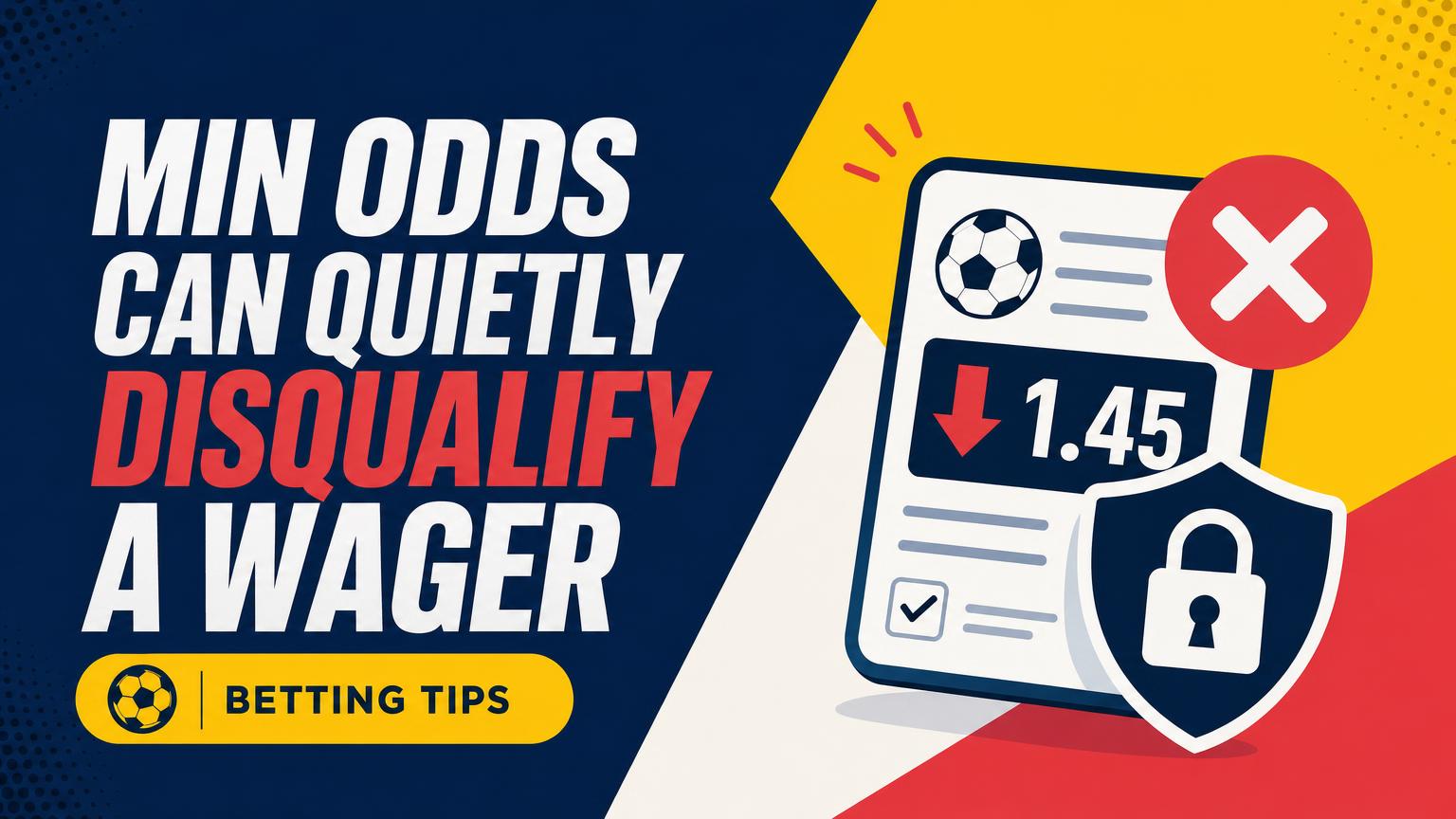
A winning bet can still earn nothing from the promotion attached to it.
The game ends, the wager settles normally, and the promised bonus never appears. The sportsbook did not void the bet or grade it incorrectly—the selected betting line simply failed the promotion’s minimum-odds requirement.
Top Sportsbook Bonuses for October 2026

BetUS

BetNow

MyBookie

Bet105

BUSR Sports

Everygame Sports

BetOnline

BetWhale

BetAnything

Xbet
Bovada

Bookmaker
That distinction matters. A moneyline, point spread, over/under, prop, or parlay can be perfectly valid as a regular cash wager while remaining ineligible for bonus credit. For example, a promotion requiring odds of -200 or longer would generally reject a -250 selection, even if the wager wins. Some books evaluate each parlay leg as well as the combined price. Because rules vary and can change, the current terms should be checked before placing the qualifying bet, especially for listed minimum odds, eligible markets, and settlement deadlines.
- At American odds, “-200 or longer” generally includes -200, -150, +100, and positive prices—not -250.
What “-200 or longer” actually means
Minimum qualifying odds are the shortest price a sportsbook accepts for a promotional wager. If the terms require odds of -200 or longer, a bet at exactly -200 qualifies, as do prices with a larger potential return.
Examples include:
- Qualifying: -200, -150, -110, +100, +200
- Not qualifying: -201, -250, -500
The wording can be confusing because -150 is considered longer than -200, even though the number looks smaller. At -150, a $150 stake would return $100 in profit; at -200, it takes $200 to win the same $100. Positive odds are longer still.
A wager can be accepted as a normal cash bet while remaining ineligible for the promotion. That distinction matters when assessing how bonus terms affect an offer’s real value.
Sportsbooks do not use one universal threshold. One offer may allow -200, while another requires -150, -110, or plus money. Parlays, live bets, props, and altered lines may also face separate restrictions. Since promotional language and eligibility rules can change, the current terms should be checked before placing the qualifying wager.
How negative odds are ordered
Negative American odds can look backward at first. With favorites, the price closer to zero is the longer price: -150 is longer than -200, while -250 is shorter than -200. The number reflects how much must be risked to win $100, so a larger required stake means a heavier favorite and a shorter price.
For a hypothetical promotion requiring minimum odds of -200, the cutoff works like this:
| American odds | Decimal equivalent | Eligible? |
|---|---|---|
| -300 | 1.33 | No |
| -250 | 1.40 | No |
| -200 | 1.50 | Yes |
| -150 | 1.67 | Yes |
| +100 | 2.00 | Yes |
| +150 | 2.50 | Yes |
A simple way to read the sequence is to move from heavy favorites toward underdogs:
-300 → -250 → -200 → -150 → +100 → +150
The odds get longer from left to right. At a -200 minimum, the qualifying range begins at -200 and continues toward -150, even money, and positive odds.
Decimal odds can provide a useful cross-check: -200 equals 1.50, so prices of 1.50 or higher generally meet the same cutoff. Sportsbooks may apply their own rounding or market restrictions, so the current promotion terms remain controlling.
Three wagers, three sets of rules
A promotion can involve up to three distinct stages. Passing the minimum-odds test at one stage does not automatically satisfy the next.
| Stage | What happens | Terms to check |
|---|---|---|
| Qualifying cash wager | A real-money bet triggers the reward. | Minimum stake, minimum odds, eligible markets, settlement deadline, and whether parlays or cash-out bets count. |
| Bonus-bet wager | The awarded bonus bet is placed later. | Its own minimum odds, eligible markets, expiration date, maximum stake, and rules against splitting or combining tokens. |
| Rollover | A specified amount must be wagered before restricted funds can be withdrawn. | Required wagering multiple, deadline, market exclusions, odds limits, and contribution rules. |
For example, a $25 cash wager at -200 might qualify for a bonus bet, while the bonus bet itself may require odds of -150 or longer. The original wager earned the reward; it did not establish the price allowed when redeeming it.
Rollover is separate again. A promotion may require no rollover, or it may attach wagering requirements to a deposit match, cash credit, or resulting funds. Bettors should confirm which wagers count toward the rollover requirement, because some markets may contribute partially or not at all.
Stake treatment can also differ. Cash stakes are normally returned with winnings on a successful wager, while bonus-bet stakes commonly are not. Current sportsbook terms control, especially for deadlines and withdrawal restrictions.
The same cutoff produces different results
Assume a promotion requires odds of -200 or longer. The first check is purely numerical: -200, -110, +100, and +150 meet the threshold, while -201, -250, and -400 do not.
| Wager | Betting line | Odds test | Possible promotion result |
|---|---|---|---|
| Favorite moneyline | -250 | Fails | Disqualified because the price is shorter than -200 |
| Point spread | -110 | Passes | Qualifies if spread bets are eligible |
| Underdog moneyline | +140 | Passes | Qualifies if moneylines are eligible |
| Player prop | -115 | Passes | Still fails if the offer excludes props |
The -250 favorite may look like a conservative pick, but that does not help with qualification. Its price falls outside the permitted range. Moving to a standard -110 point spread clears the odds requirement, though the spread must also be an approved market.
A +140 underdog easily passes the same numerical test. Plus-money odds are longer than -200, but the wager could still be rejected for another reason, such as placement after the promotional deadline or use in an ineligible parlay.
The player prop shows why the two checks should remain separate. A prop priced at -115 passes the minimum-odds rule, yet some promotions cover only moneylines, spreads, and totals. In that case, the bet is valid for normal sportsbook settlement but not for the offer.
Before placing a qualifying wager, verify both:
- Price: Is the final accepted line -200 or longer?
- Market: Does the current offer permit that bet type, league, and parlay format?
Parlays and boosts add another layer
A parlay can show qualifying final odds while still containing a leg that violates the promotion’s minimum. Sportsbooks handle this differently: one may evaluate only the combined parlay price, while another checks every individual leg. A three-leg parlay priced at +180, for example, might be rejected if one leg is -500 and the terms set a -200 minimum for each selection.
Boosted odds may not control
An odds boost can move a wager from -220 to -180, but that does not automatically make it eligible. The sportsbook may use:
- The boosted price shown on the bet slip
- The original, unboosted price
- A separate minimum specifically for boosted wagers
- A rule prohibiting a bonus bet or promotion from being combined with a boost
These restrictions often appear alongside odds boost limits and payout caps, so the full offer terms matter more than the headline price.
Use the accepted ticket as the reference
Betting lines can move between adding a selection and submitting the wager. The critical number is generally the price accepted on the confirmed ticket, not the earlier line on the market screen. If a line shifts from -195 to -205 before acceptance, a promotion requiring -200 or longer may no longer apply.
Screenshots of the confirmed bet and current terms can help if qualification is unclear. The sportsbook’s settled promotional status remains controlling.
For parlays and boosts, verify whether the minimum applies to the final price, each leg, or the original odds. Also confirm that stacking promotions is allowed.
Settlement Details That Can Change Eligibility
Do pushes, voids, and canceled events count?
Treatment varies by promotion. A push may be settled but not eligible, while a canceled event or fully voided wager may be excluded entirely; the terms’ definitions of “completed,” “settled,” and “eligible wager” control.
Does an early cash-out satisfy the requirement?
Often it does not, even when the sportsbook records the ticket as settled. Some offers require the wager to settle normally, so accepting an early cash-out can remove promotional eligibility.
Are live bets, late wagers, and same-game parlays eligible?
Not automatically. Live betting and same-game parlays may be excluded, while a wager placed near the deadline may qualify only if placement—not final settlement—must occur before expiration.
Do free-to-play funds follow the same rules as bonus-bet winnings?
No. Free-to-play credits may have separate eligible markets, odds, and withdrawal rules. Promotional qualification should also be separated from whether a winning bonus bet returns its stake; those are different mechanics, and current sportsbook terms should be checked for both.
Check eligibility before counting on the reward
-
Opt in before placing the wager
Confirm that enrollment succeeded. Some promotions do not apply retroactively, even when every other requirement is met.
-
Verify the promotional window
Check the opt-in, wager placement and settlement deadlines. Read the current terms rather than relying on an offer banner or earlier version.
-
Confirm the wager and payment method
Make sure the market, bet type and funding source qualify. Props, parlays, boosts, bonus funds and deposits made through certain methods may be restricted.
-
Review the accepted ticket
Recheck the final accepted odds—not just the price shown on the bet slip. Line movement or a boost can affect whether the wager clears the minimum.
-
Save the evidence
Keep screenshots of the offer, terms, opt-in confirmation and accepted ticket. Retain the bet ID through settlement and reward crediting.
-
Ask support before relying on an unclear bet
If eligibility remains uncertain, contact sportsbook support before placing the wager. Save the transcript and avoid treating an unconfirmed bet as the one that unlocks the reward.
Promotion rules can change; current sportsbook terms control eligibility.
Treat the cutoff as a gate
- Check before betting Compare the accepted ticket price with the promotion’s cutoff before placing the wager. If it falls outside the range, assume no reward.
- Avoid forced value Do not replace a preferred -250 favorite with a riskier -190 wager solely to qualify. The potential bonus may not justify the added variance.
- Never chase eligibility A disqualified wager is not a reason to bet again or increase the stake. Promotional value cannot erase vig or loss risk.
Current sportsbook terms control; minimum odds, eligible markets, and deadlines can change.
Minimum odds answer a pre-bet question: Does this wager qualify? They should not dictate the handicap or bankroll decision. If eligibility requires a bet that no longer makes sense, skipping the promotion is often the more disciplined choice.
Top Sportsbook Bonuses for October 2026
BetUS
BetNow
MyBookie
Bet105
BUSR Sports
Everygame Sports
BetOnline
BetWhale
BetAnything
Xbet
Bovada
