
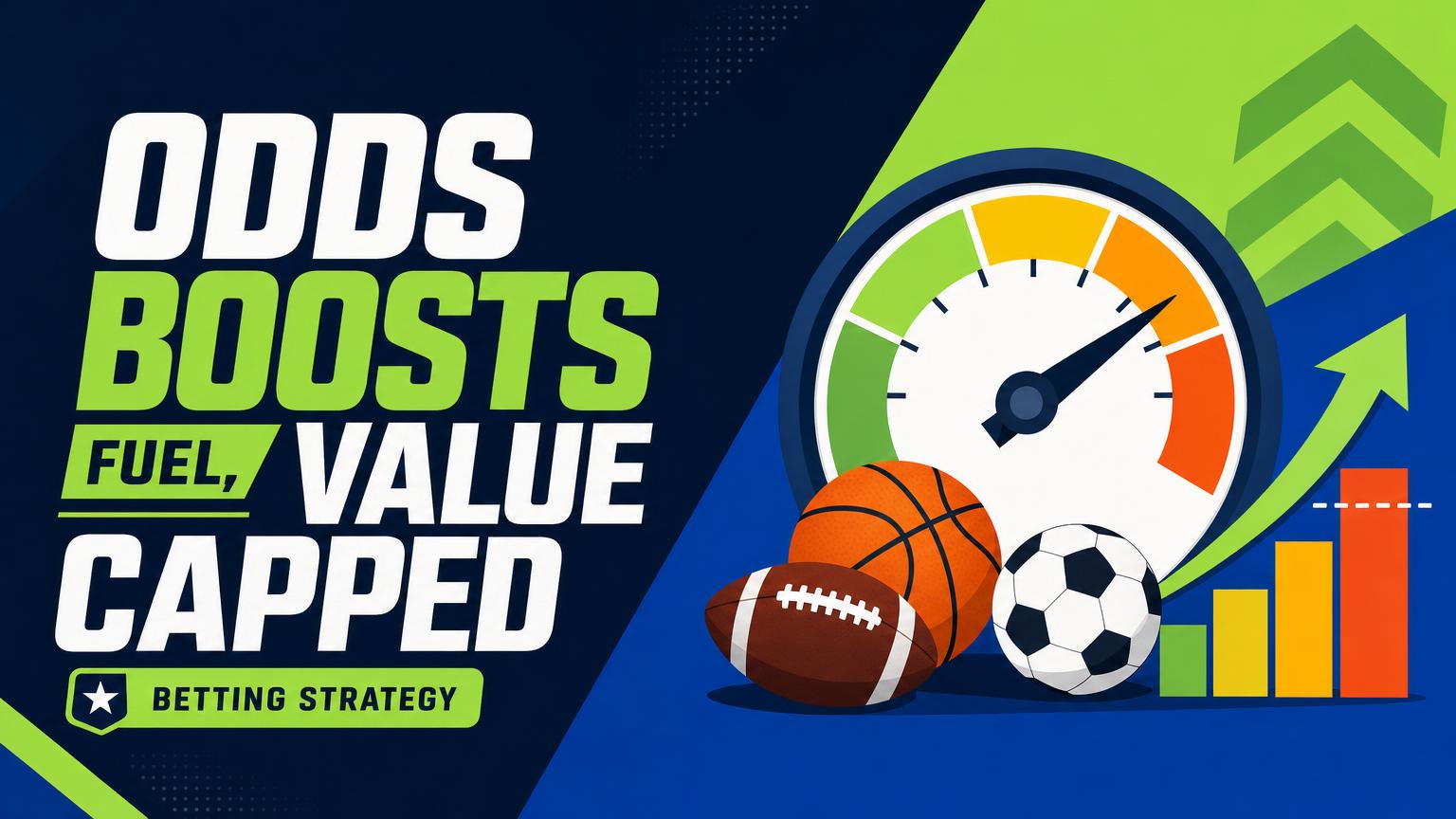
A flashy odds boost can shrink to pocket change once the wager cap and fine print take effect.
Suppose a sportsbook offers a 50% profit boost, but limits the qualifying stake to $10. A standard -110 bet would normally return about $9.09 in profit; boosting that profit by 50% raises it to roughly $13.64. The eye-catching promotion adds only about $4.55 in potential winnings.
Top Sportsbook Bonuses for October 2026

BetUS

BetNow

MyBookie

Bet105

BUSR Sports

Everygame Sports

BetOnline

BetWhale

BetAnything

Xbet
Bovada

Bookmaker
That extra value still matters, but improved odds cannot rescue a poor wager. If the original betting line overstates a team’s chances—or the market is available at a better price elsewhere—the boost may offer little genuine value. Eligible markets, minimum odds, stake limits and payout caps can narrow the benefit further, so current sportsbook terms should always be checked before placing the wager.
Two Ways Sportsbooks Boost Odds
- Percentage profit boost
The sportsbook increases the wager’s potential profit by a stated percentage, such as 25%. A $20 bet that normally earns $20 profit would earn $25; the original $20 stake is still returned separately.
- Pre-boosted odds
The sportsbook replaces the standard price with a higher promotional price—for example, moving a moneyline from +150 to +200. The enhanced odds determine profit, while the returned stake remains unchanged.
- Stake and payout limits
Both structures may impose a maximum wager or cap the additional winnings. Minimum odds, eligible markets, opt-in rules and expiration times can also determine whether the boost applies.
- Other promotional mechanics
An odds boost changes the payout on a qualifying cash wager. Bonus bets, deposit matches and bet insurance work differently: they may award promotional credit, require additional action or refund a losing bet under specific terms. These distinctions matter when comparing how sportsbook promotions create value.
How to Calculate a Boosted Payout
For a percentage boost, the advertised increase usually applies to profit only, not the returned stake.
Boosted profit = base profit × (1 + boost percentage)
Total return = stake + boosted profit
Base profit can be calculated from American odds:
- Positive odds: stake × (odds ÷ 100)
- Negative odds: stake × (100 ÷ absolute odds)
Percentage boost example
A $100 wager at +150 normally produces $150 in profit. With a 20% profit boost:
- Boost amount: $150 × 20% = $30
- Boosted profit: $150 + $30 = $180
- Total return: $100 stake + $180 profit = $280
That boost effectively moves the price from +150 to +180, assuming the full $100 wager qualifies and no promotional cap applies.
Fixed-price example
A pre-boosted price requires no percentage calculation. If a sportsbook changes a line from -110 to +100, a $100 wager uses +100 directly and returns $200 total: $100 in profit plus the $100 stake.
| Offer | Stake | Profit | Total return |
|---|---|---|---|
| +150 standard | $100 | $150 | $250 |
| +150 with 20% boost | $100 | $180 | $280 |
| Fixed promo price +100 | $100 | $100 | $200 |
Sportsbooks may display converted American odds rounded to the nearest whole number. The underlying decimal price can therefore produce a payout that differs by a few cents from hand calculations. Current promotion terms and the bet slip provide the controlling payout.
Three Caps That Limit a Boost’s Value
A promotion’s headline percentage does not reveal its maximum dollar value. The cap’s wording determines which part of the wager gets restricted.
| Cap type | What it limits |
|---|---|
| Qualifying-stake cap | The portion of the wager receiving boosted odds |
| Boosted-winnings cap | The profit allowed under the boosted price; terms may instead define this as additional boost profit |
| Total-payout cap | The full return, often including the original stake |
Consider a 20% profit boost at +150 with a $20 qualifying-stake cap. A $20 eligible stake normally earns $30 profit. The boost adds 20% of that profit, or $6, producing $36 profit and a $56 return.
If $100 is wagered but only $20 qualifies, the extra benefit remains just $6. Assuming the remaining $80 is accepted at the standard +150 price, total profit rises from $150 to $156. Despite the advertised 20% boost, the effective increase across the wager’s normal profit is only 4%.
Sportsbooks may instead reject wagers above the promotional maximum or apply the boost only when the entire bet stays within the cap. Parlays, props, live bets, and certain minimum-odds selections may also be excluded.
Some terms cap total boosted profit; others cap only the extra amount created by the boost. Confirm whether stake is included and check eligible markets, minimum odds, and expiry before placing the wager.
Check Eligibility Before Placing the Bet
Boost terms should be checked before the bet slip is submitted. A wager that misses one condition usually receives the standard odds, even if every other requirement is met.
Use this quick audit:
- Activation: Opt in or add the boost token to the bet slip when required.
- Timing: Confirm the promotion window, expiration time and whether the event must start before the deadline.
- Market: Check which leagues, games and markets qualify. Live bets, futures, alternate lines and certain props are often excluded.
- Bet type: Verify whether singles, parlays, same-game parlays or round robins are eligible.
- Odds: Compare the original line—not only the boosted price—with the required minimum odds.
Other common exclusions include cash-out wagers, voided legs, free bets, bonus funds and bets placed with another promotion. Limits may also vary by customer, state or sport, so the current sportsbook terms control.
Why parlays require extra attention
A minimum-odds rule can apply to the entire parlay, each individual leg, or both. For example, a parlay priced at +200 may still be ineligible if one leg is -500 and every leg must be -300 or longer. These minimum-odds restrictions on promotional wagers can be easy to miss when the bet slip displays only the combined price.
Before confirming, the bettor should verify that the boost appears on the slip and save the terms or a screenshot in case the grading differs from expectations.
Judge the Final Price, Not the Boost
A large advertised percentage can still produce an ordinary—or unfavorable—betting line. The useful comparison is the boosted price versus the wider market, not the boosted price versus that sportsbook’s original odds.
Break-even probability shows how often a wager must win to avoid losing money over time:
- Negative American odds: odds ÷ (odds + 100)
- Positive American odds: 100 ÷ (odds + 100)
For example, a $100 wager at -120 earns $83.33 in profit. A 20% profit boost raises that profit to $100, effectively creating +100 odds. The break-even rate falls from 54.55% to 50%.
That is a meaningful reduction in vig, but it does not guarantee positive expected value. If comparable sportsbooks list the same selection at +105, their regular line is better than the boosted +100 price. At +105, the break-even rate is about 48.78%.
Before using a boost, compare:
- The final boosted odds
- Prices at other legal sportsbooks
- The market’s likely fair probability after removing juice
- Any stake or payout cap
A boost creates value only when the final price is better than the selection’s realistic probability justifies. A weak starting line can absorb much of the promotion before the wager becomes competitive.
Calculate the boost’s real dollar ceiling
For a percentage boost with a maximum eligible stake, the most useful number is the maximum extra profit:
Eligible stake × profit per dollar × boost percentage
For negative American odds, profit per dollar equals 100 ÷ absolute odds. If a 20% boost is capped at a $25 wager and the qualifying line is -110:
- Base profit:
$25 × (100 ÷ 110) = $22.73 - Extra profit:
$22.73 × 20% = $4.55 - Boosted profit:
$27.28after rounding - Total return, including stake:
$52.28
So the promotion’s practical ceiling is only $4.55 in added profit on that wager. A separate maximum-winnings or maximum-payout rule could reduce it further. Sportsbook settlement rounding may also create a one-cent difference.
Why long parlays can distort the picture
A boost on a +1000 parlay can display a much larger nominal return because the base profit is already high. That does not automatically make it stronger value. Parlays have a low hit rate, and the sportsbook’s hold can be embedded in every leg, compounding the juice as legs are added.
Restrictions also matter. Minimum leg odds, excluded props, maximum boosted winnings and requirements that every leg settle as a win can narrow the apparent upside. The useful comparison is the boosted parlay price against the fair combined probability—not merely the dollar payout shown on the bet slip. Current promotion terms should always be checked before wagering.
What Happens After the Bet Changes?
What happens if a boosted wager pushes or is voided?
A push or void usually returns the cash stake, but the boost token may not be restored. Operator rules distinguish canceled events, grading errors and market-specific pushes.
How is a canceled parlay leg handled?
The leg is commonly removed and the parlay odds recalculated. That change can reduce the boost, trigger a payout cap or make the remaining wager ineligible.
Does cashing out preserve the boost?
Often not; cash-out values may exclude promotional winnings or cancel the promotion entirely. The displayed cash-out amount should be reviewed before accepting.
Are boosted odds final after placement?
The accepted bet slip normally controls settlement, though palpable-error and event-change rules may apply. Token returns, regraded wagers and adjusted odds vary by sportsbook, so current operator terms are decisive.
Run This Check Before Placing a Boosted Bet
-
Activate it
Opt in and confirm the token appears before building the wager.
-
Check eligibility
Match the market, odds, bet type and deadline to the current terms.
-
Read every cap
Identify maximum stake, boosted winnings and total payout limits.
-
Calculate cash return
Convert the boost into added profit and total return at the intended stake.
-
Shop and verify
Compare the final price across sportsbooks, then confirm the boost, odds and stake on the bet slip.
Save or screenshot the terms because promotions can change or disappear.
Keep the normal stake size. Never chase losses, oversize a wager or force extra parlay legs just to use a promotion.
A useful boost survives the terms, improves the market price and fits a wager that already makes sense.
Top Sportsbook Bonuses for October 2026
BetUS
BetNow
MyBookie
Bet105
BUSR Sports
Everygame Sports
BetOnline
BetWhale
BetAnything
Xbet
Bovada
