

An attractive payout is useless when the wager’s winning condition is misunderstood.
An NFL bet slip might show the favorite at -3.5, a -180 moneyline, an over/under of 47.5, and several player props—all for the same game. Each wager answers a different question. A team can win the game while failing to cover the point spread, or a quarterback can play well without clearing a passing-yard prop.
Top Sportsbook Bonuses for October 2026

BetUS

BetNow

MyBookie

Bet105

BUSR Sports

Everygame Sports

BetOnline

BetWhale

BetAnything

Xbet

Bovada

Bookmaker
Before placing a wager, a bettor should be able to explain exactly what result makes it win, lose, or push. The posted odds determine the potential return; they do not change the grading rules. Overtime treatment, voided player props, dead heats, and stat corrections can also vary by market or sportsbook, making the house rules worth checking before chasing a tempting plus-money price.
Terms That Define the Wager
- Market and selection
The market is the type of bet, such as a point spread or game total. The selection is the specific side or outcome being backed.
- Stake or risk
The amount committed to the wager. On a standard cash bet, this is the most that can be lost.
- American odds
Odds with a plus sign show the profit from a $100 stake. Minus odds show the stake required to make $100 in profit.
- Profit and total return
Profit is the amount won beyond the original stake. Total return—sometimes labeled payout—usually combines profit and the returned stake.
- Push or void
A push lands exactly on the sportsbook’s posted number, while a void means the wager is canceled. Both commonly return the stake, although parlay treatment can differ.
At +150, a $20 stake produces $30 profit: $20 × 1.50. The total return is $50, including the original stake.
At -120, a $24 stake produces $20 profit: $24 ÷ 1.20. The total return is $44.
These calculations describe the listed price, not whether the bet will be graded as a winner. Settlement can depend on current house rules covering overtime, canceled games, stat corrections, dead heats, and other sport-specific conditions. The bet slip and sportsbook rules should be checked before placing the wager.
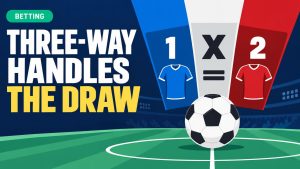
When a Draw Is Possible
Consider a hypothetical Arsenal–Chelsea knockout match. The same matchup can produce very different wagers depending on whether the market ends after 90 minutes or continues through extra time and penalties.
| Market | Example odds | What a 90-minute draw means |
|---|---|---|
| Two-way moneyline—to advance | Arsenal -135; Chelsea +115 | The wager remains live through the stated tiebreaker period. One side must advance. |
| Three-way moneyline—90 minutes | Arsenal +120; Draw +230; Chelsea +220 | Team bets lose; only the draw wager wins. |
| Draw no bet—90 minutes | Arsenal -155; Chelsea +125 | The stake is refunded. |
A three-way moneyline usually offers a better price on either team because a draw becomes a separate losing outcome. Draw no bet removes that risk, but the added protection produces shorter odds and less potential profit.
A two-way market requires extra attention to its label. “To advance” commonly includes extra time and penalties, while a standard two-way moneyline in another sport may grade an official tie as a push. Sportsbook house rules control settlement, so the listed game period and overtime terms should be checked before placing the wager.
One Score, Several Different Results
A moneyline asks which team wins. A point spread measures the victory margin, while an over/under measures scoring rather than the winner.
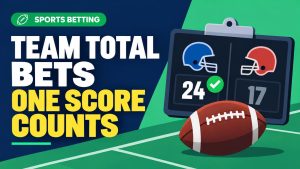
Suppose the home team wins 27–24. The margin is 3 points, the combined score is 51, and the home team scored 27.
| Wager | Result | Why |
|---|---|---|
| Home moneyline | Win | The home team won outright. |
| Home -3 | Push | The 3-point margin exactly matches the spread. |
| Home -2.5 | Win | The margin clears the spread. |
| Away +2.5 | Loss | The away team needed to lose by 2 or fewer. |
| Over 51 | Push | The teams scored exactly 51. |
| Over 50.5 | Win | The combined score exceeded 50.5. |
| Under 51.5 | Win | The combined score stayed below 51.5. |
| Home team total over 26.5 | Win | The home team scored 27. |
| Home team total over 27 | Push | The score landed exactly on the line. |
Alternate totals settle the same way as regular totals; they simply offer a different line at different odds. Half-points such as 2.5 or 50.5 eliminate the possibility of landing exactly on the number. On standard straight bets, a push usually returns the stake, though sportsbook rules should always be checked.
Props, Period Bets, and Futures
House rules control grading, so terms should be checked before placing the wager.
Parlays and same-game parlays
A parlay combines two or more selections into one wager. The odds are multiplied, increasing the potential return as legs are added. The tradeoff is strict: every active leg must win; one losing leg normally defeats the entire ticket.
Regular vs. same-game parlays
A regular parlay typically links selections from different events, such as an NFL point spread and an NBA moneyline. A same-game parlay (SGP) combines markets from one event—perhaps a quarterback passing prop, a receiver prop, and the game total.
Because SGP outcomes can influence one another, sportsbooks account for correlation when setting odds. They may reprice or block closely related combinations rather than multiply the displayed prices directly.
Grading can also change the payout:
- Loss: The entire parlay loses.
- Push or void: The affected leg is commonly removed, with odds recalculated from the remaining legs.
- No active legs left: The stake is generally refunded.
House rules differ, especially for voided SGP legs. A sportsbook may reprice the wager or void the full ticket, so settlement rules should be checked before betting.
These wagers combine selections differently, so the same picks can create very different bankroll exposure.
| Bet type | Structure and stake | Line adjustment | Payout profile |
|---|---|---|---|
| Parlay | One wager; every active leg must win | None required | Highest potential return, but one loss usually defeats the ticket |
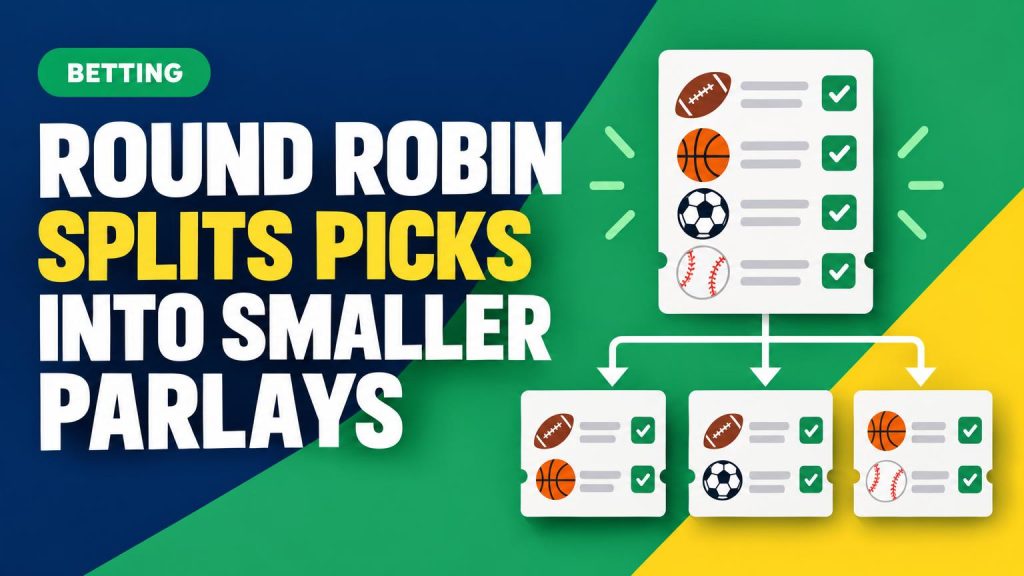
| Round robin | Multiple smaller parlays; total stake rises with the number of combinations | None required | Some combinations can cash when another pick loses |
| Teaser | One multi-leg wager, usually on football spreads or totals | Lines move in the bettor’s favor | Lower payout than a comparable parlay |
A round robin spreads risk across separate combinations; it does not make weak picks safer. Check the bet slip’s total cost, not merely the amount per combination.
Likewise, teaser points improve the betting lines but come with reduced odds and multiple legs that still must qualify. Push treatment varies by sportsbook: a push may reduce the number of legs, void the wager, or grade certain teasers as losses. House rules should be checked before confirming the wager.
Live betting and cash-out decisions
Live betting lines update as the score, clock, possession, player availability, and game flow change. A touchdown can flip a moneyline favorite, while a fast scoring pace may push an over/under higher.
Sportsbooks often suspend live markets during consequential moments such as a field-goal attempt, replay review, penalty, injury, or possible goal. The pause prevents wagers from being accepted before the sportsbook’s data and traders have caught up with the action. Markets may reopen seconds later with different odds or remain closed if the outcome is nearly settled.
A full cash out closes the entire wager for the displayed amount. A partial cash out returns part of that amount while leaving a smaller stake active. Neither offer is guaranteed to remain available, and values can change or disappear quickly.
Cash-out prices generally include sportsbook margin, so the offer may be lower than the bet’s estimated fair value. Accepting can reduce risk or protect bankroll, but letting the wager ride may offer better expected value. The sensible choice depends on the price, remaining uncertainty, and the bettor’s risk tolerance—not simply whether the offer shows a profit.
Before Placing the Bet
-
Confirm the exact outcome
Read the selection and betting line carefully. Note whether the wager covers regulation time, overtime, or a specific period.
-
Check settlement rules
Sportsbook house rules determine how pushes, voids, ties, postponements, and player props are graded.
-
Add the total exposure
Count the full stake alongside all open bets, including every combination in a round robin.
-
Review the payout
Verify the stake, potential profit, and total return. Short odds or heavy juice can make the risk easy to underestimate.
-
Recheck promotion terms
Confirm eligible wagers, minimum odds, qualifying deposits, expiration dates, and withdrawal restrictions before betting.
A losing bet does not make the next wager more likely to win. Increasing stakes to recover money can quickly overwhelm a bankroll. Pause instead, and bet only an amount already set aside for gambling.
Straightforward single bets are usually easier for beginners to price, track, and settle than multi-leg wagers. Market complexity should be added only when the rules and full financial exposure are clear.
Top Sportsbook Bonuses for October 2026
BetUS
BetNow
MyBookie
Bet105
BUSR Sports
Everygame Sports
BetOnline
BetWhale
BetAnything
Xbet
Bovada
