
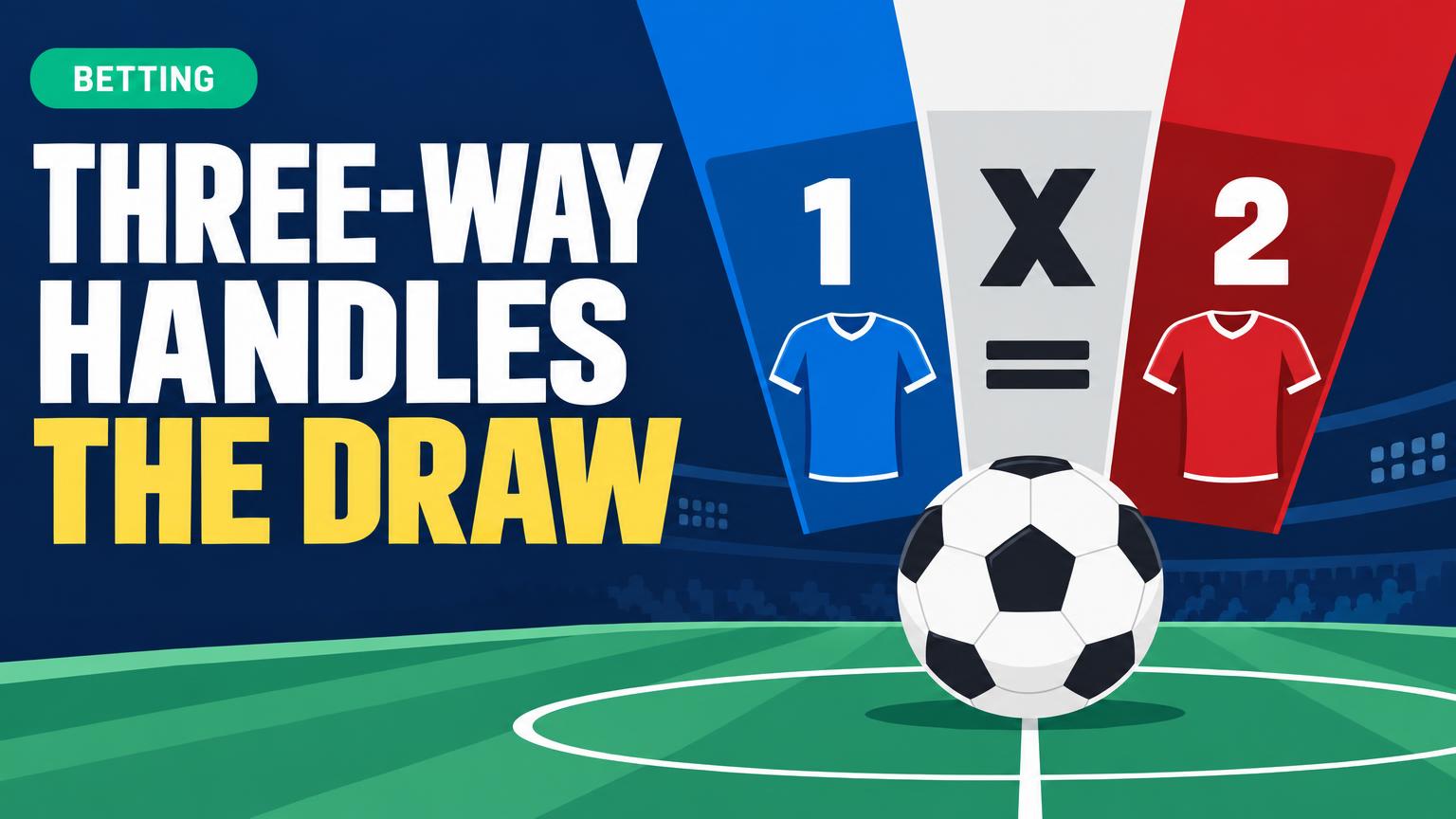
A team can avoid defeat while its moneyline wager still loses.
A bettor backs the home team in a soccer match, and the final whistle blows at 1–1. The team did not lose, but the Home wager did. On a three-way moneyline, Home, Draw, and Away are separate outcomes. A tied match pays the Draw wager; wagers on either team lose rather than push or refund.
The market usually settles on the score after 90 minutes plus stoppage time, not extra time or penalties, unless the sportsbook says otherwise. A bettor looking for a refund on a tie should check for a separate draw no bet market before placing the wager.
What the three-way moneyline pays on
A three-way moneyline, often labeled 1X2, offers three possible selections for the same match: 1 for the home team to win, X for a draw, and 2 for the away team to win. The outcomes are mutually exclusive. Only one selection can win when the market is settled.
If the match finishes level, the draw selection wins. A wager on either team loses; it is not refunded simply because neither side won. For example, a 1–1 finish settles as X, regardless of which team was favored in the odds.
That makes 1X2 different from draw no bet, which returns the stake on a draw, and from a two-way moneyline, which has only two listed selections. It also differs from a point spread, where a team’s winning margin matters. The guide to sports bet types and markets puts those options in context. Checking the market label before placing a wager helps avoid mistaking one set of draw rules for another.
Match result versus team to qualify
A standard soccer match-result wager is usually settled on the score after 90 minutes plus stoppage time. Extra time and a penalty shootout do not change that result unless the sportsbook explicitly lists a different settlement period.
Consider a knockout match tied 1–1 at the end of stoppage time. The draw wins on a three-way match-result line, even if the home team scores in extra time or wins a shootout. A wager on the home team to win the match-result market would lose.
A team to qualify wager answers a different question: which team advances to the next round? If that same home team ultimately advances, its “to qualify” selection wins even though the match-result bet settled as a draw. Qualification markets generally account for extra time and penalties when needed, but the market description and sportsbook rules determine exactly what counts.
Before placing a wager, check the market name and listed period. “Match result,” “90 minutes,” and “to qualify” are not interchangeable, especially in knockout games where a level score can lead to more play.
The sportsbook’s posted market terms and house rules control settlement. If a listing includes extra time or penalties, that wording takes precedence over the usual 90-minute convention.
What a $10 wager pays on each outcome
Suppose a sportsbook lists Home +120, Draw +240, and Away +210. Each is a separate three-way moneyline selection. The table shows what a single $10 wager pays if its selection wins—and what happens if it loses.
| $10 selection | If it wins | Profit | Total return | If it loses |
|---|---|---|---|---|
| Home +120 | Home wins | $12 | $22 | −$10 |
| Draw +240 | Match ends tied | $24 | $34 | −$10 |
| Away +210 | Away wins | $21 | $31 | −$10 |
Total return includes the original $10 stake. For example, a match that finishes 1–1 makes Draw +240 the winning selection: it earns $24 in profit and returns $34 altogether. A $10 wager on Home +120 loses $10, as does a separate $10 wager on Away +210. Neither team selection gets its stake back because the teams finished level.
Those figures describe individual wagers. If someone placed $10 on all three outcomes, that bettor would stake $30 in total. At 1–1, the $34 draw return would leave a $4 net gain after the two losing wagers. A home win, however, would return only $22 against the same $30 staked—a net loss of $8. Covering every outcome does not automatically lock in a profit; the combined payouts depend on the odds offered.
The draw has its own price
In a three-way moneyline, the draw is a priced result, not a refund condition. A draw wager wins if the match finishes tied under the market’s settlement rules; a home or away wager loses. The higher return on a draw bet reflects its odds, not a promise of better value.
The $10 returns in the example translate to decimal odds by dividing each total return by the stake. Dividing 1 by those decimal odds gives each outcome’s implied probability:
| Result | $10 total return | Decimal odds | Implied probability |
|---|---|---|---|
| Home win | $22 | 2.20 | 45.5% |
| Draw | $34 | 3.40 | 29.4% |
| Away win | $31 | 3.10 | 32.3% |
Those probabilities add up to about 107.1%, even though only one result can occur. The extra 7.1 percentage points reflect the sportsbook’s built-in margin, often called vig or juice. They should not be read as three independent forecasts that somehow exceed certainty.
At 3.40 decimal odds, a draw wager needs to win more than about 29.4% of the time to have positive expected value at that price. A $34 return may look attractive beside $22 for a home win, but payout size alone says nothing about value. The question is whether the draw is more likely than the betting line implies.
How other markets settle a draw
A draw does not have the same effect across betting markets. The distinction matters before placing a wager on a match that could finish level.
| Market | What happens if the match ends in a draw? |
|---|---|
| Three-way moneyline (1X2) | A draw selection wins. Home and away selections lose. |
| Draw no bet | A home or away selection is refunded. |
| Two-way market | Settlement depends on the posted rules. A tie may void the wager, or the market may include overtime to produce a winner. |
| Double chance | A home-or-draw or away-or-draw selection wins. A home-or-away selection loses. |
Double chance covers two of the three possible results. That extra coverage usually comes with shorter odds than a straight three-way pick on the same team, so the potential payout is smaller for the same stake. Unlike draw no bet, a home-or-draw wager wins rather than refunds the stake when the match finishes level.
A two-way moneyline needs a closer look at the sportsbook’s tie rules for standard moneyline bets. The market name alone does not establish whether a regulation draw is void or whether extra time counts. Before placing a wager, check the event’s settlement period and the rules for ties; similarly named lines can settle differently.
Three-way moneyline settlement questions
Does stoppage time count?
Yes. A standard soccer match-result wager includes the referee’s added time at the end of each half, so a goal scored at 90+4 can change the result.
Does extra time count in a three-way moneyline?
Usually not. The standard match-result market settles after regulation and stoppage time, even if a knockout game continues into extra time or a penalty shootout. Check the betting line if it specifies a different period.
What happens if a match is abandoned?
Settlement depends on the sportsbook’s house rules and how much of the match was completed. The wager may be voided or settled under a stated completion rule; the score when play stopped does not necessarily decide it.
What if the match is postponed?
Sportsbooks typically set a time window for the match to be played before a wager is voided. That window varies, so check the market rules and the wager’s status before assuming it carries over.
Is a drawn match a dead heat?
No. The draw is its own priced selection in a three-way moneyline. Dead heat settlement rules concern tied finishers sharing a placing, not a soccer match ending level.
Check the three-way line before submitting
-
Find all three selections
A three-way moneyline lists a home win, a draw and an away win. If the draw is not shown, check the market name before assuming the bet settles the same way.
-
Confirm the settlement period
For soccer, the standard match-result market covers 90 minutes plus stoppage time. Check the sportsbook’s rules if extra time or a penalty shootout is possible.
-
Separate the result from advancement
A team can advance after a draw in regulation. A three-way wager on that team to win the match still loses if the covered period ends level.
-
Review the odds and stake
Check that the selected outcome, odds, wager amount and potential return on the bet slip match the intended bet before submitting.
If a parlay includes a three-way team-win selection, a draw makes that leg lose—even if the team later advances. Check each leg’s market, not just the team name.
A three-way moneyline pick backs one result—home win, draw, or away win—within the period stated on the betting line. A tied score does not refund a home- or away-win wager; the draw has its own price. In a knockout match, the team that advances may not be the team that won during the period used to settle the bet.
For protection against a tie, compare draw no bet versus moneyline rules and odds before placing a wager. A refund rule can come with a different payout, so both terms matter. Whatever the selection, keep the stake within a planned bankroll.
