
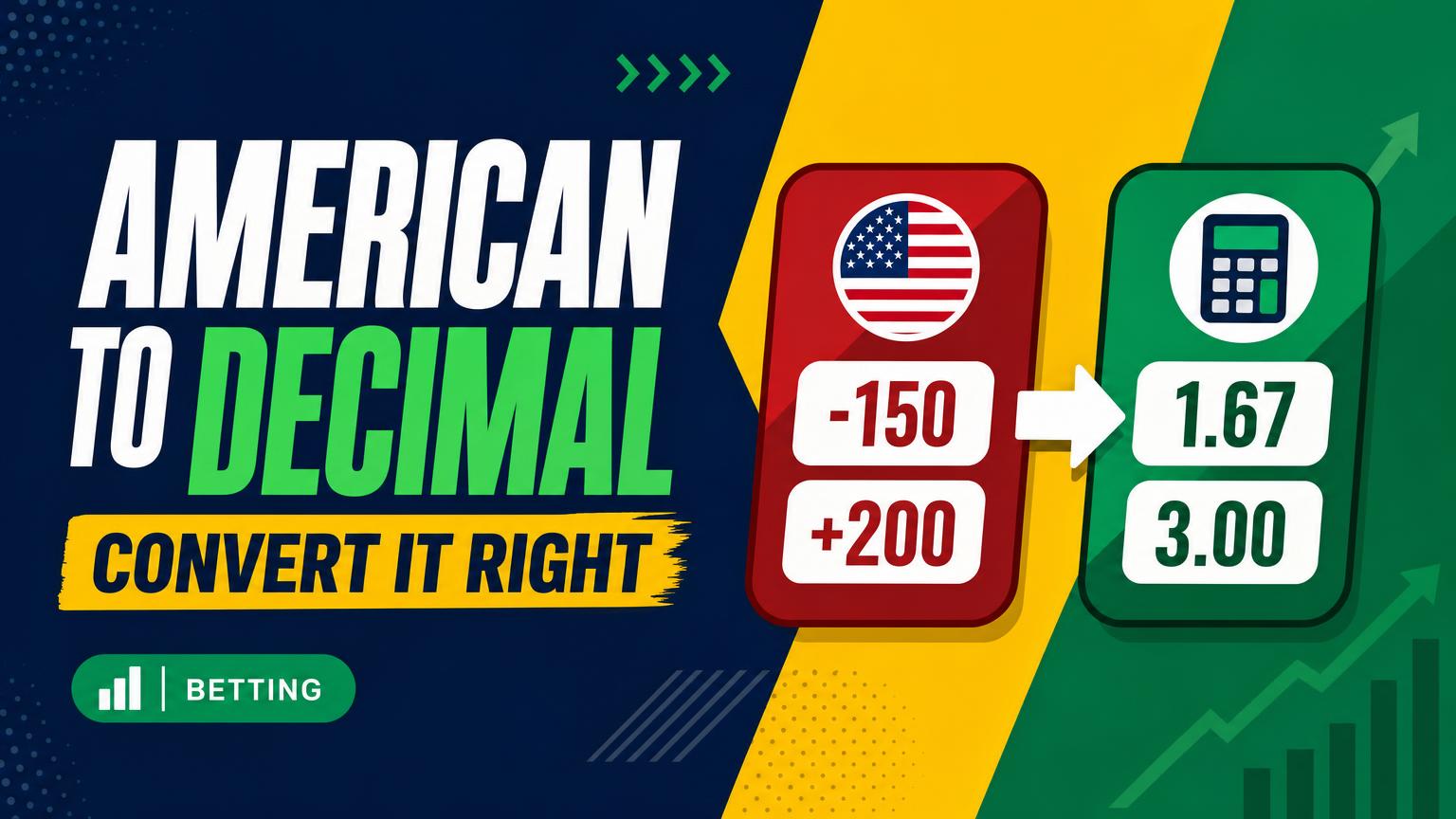
One misplaced minus sign can turn an ordinary betting line into imaginary value.
A sportsbook lists a favorite at -135, while another displays the same price as 1.74. Those odds are nearly equivalent: converting -135 correctly gives 1 + (100 ÷ 135) = 1.7407. On a $50 wager, that decimal price returns about $87.04, including the original stake.
Top Sportsbook Bonuses for October 2026

BetUS

BetNow

MyBookie

Bet105

BUSR Sports

Everygame Sports

BetOnline

BetWhale

BetAnything

Xbet

Bovada

Bookmaker
The mistake is treating -135 like positive odds and calculating 1 + (135 ÷ 100) = 2.35. That false result suggests a $117.50 return and makes the line appear far more attractive than it is. Accurate conversion matters when comparing sportsbooks, checking parlay legs, or estimating payouts. The rule is simple: positive and negative American odds require different formulas, and the sign should always be checked before calculating.
Read the sign before calculating
American odds and decimal odds describe payouts from different starting points. Understanding how sports betting odds work prevents the most common conversion error: applying the wrong formula.
| Odds format | What the number means | Example |
|---|---|---|
| Positive American odds | Profit from a $100 wager | At +150, a $100 bet earns $150 profit and returns $250 total. |
| Negative American odds | Stake required to earn $100 profit | At -150, a $150 bet earns $100 profit and returns $250 total. |
| Decimal odds | Total return for each $1 wagered | At 2.50, a $100 bet returns $250, including the original stake. |
The sign must be checked before touching a calculator. A plus sign calls for the positive-odds formula, while a minus sign calls for the negative-odds formula.
The key distinction is that American odds quote profit, while decimal odds quote total return. Decimal odds therefore include the wager itself; they do not represent profit alone.
Convert positive American odds
For American odds with a plus sign, divide the odds by 100 and add 1:
Decimal odds = (American odds ÷ 100) + 1
The number before adding 1 represents the potential profit relative to the stake. The added 1 restores the original stake, because decimal odds show the total potential return rather than profit alone.
For a +150 moneyline:
- Divide 150 by 100: 150 ÷ 100 = 1.50
- Add 1 for the returned stake: 1.50 + 1 = 2.50
So, +150 converts to 2.50 decimal odds. A $100 wager would return $250 in total if it wins: $150 in profit plus the original $100 stake.
| American odds | Calculation | Decimal odds |
|---|---|---|
| +125 | (125 ÷ 100) + 1 | 2.25 |
| +150 | (150 ÷ 100) + 1 | 2.50 |
| +200 | (200 ÷ 100) + 1 | 3.00 |
A quick reasonableness check helps prevent errors: positive American odds always convert to decimal odds above 2.00. Forgetting the added 1 would show profit only, not the full payout displayed by most sportsbooks using decimal pricing.
Convert negative American odds
For negative American odds, use:
Decimal odds = (100 ÷ |American odds|) + 1
The vertical bars mean absolute value: ignore the minus sign and use the line as a positive number in the calculation. The sign identifies the correct formula; it is not carried into the division.
Example: -200
For a -200 moneyline:
(100 ÷ 200) + 1 = 1.50
A $200 wager would return $300 in total if it wins: $100 in profit plus the original $200 stake.
Example: -110
A standard -110 point spread or over/under converts as follows:
(100 ÷ 110) + 1 = 1.909090…
The precise result repeats, but a sportsbook or odds converter may display it as 1.91. That displayed price is rounded to two decimal places; it is not mathematically identical to the full conversion.
A quick check helps catch errors: negative American odds should convert to decimal odds between 1.00 and 2.00. The more negative the line, the closer the decimal price moves toward 1.00.
Entering 100 ÷ -110 + 1 produces about 0.09, which cannot be valid decimal odds. Convert -110 to its absolute value, 110, before dividing.
Handle even money and rounding
Both +100 and -100 convert to 2.00 decimal odds. The formulas approach even money from opposite directions, but each represents a $100 profit on a $100 stake, with $200 returned in total. Some sportsbooks favor +100 notation, while others may display -100; there is no price difference.
Round only at the end
A line of -110 converts to 1.909090…, usually displayed as 1.91. Keep the unrounded figure during calculations—especially for payouts, implied probability, or parlay legs—and round only the final displayed result. Reusing 1.91 introduces a small error that can compound across several selections.
Decimal odds also make nearby prices easier to inspect:
| American | Exact decimal | Display |
|---|---|---|
| -110 | 1.909090… | 1.91 |
| -105 | 1.952380… | 1.95 |
That gap is real but modest: at a $100 stake, the difference in total return is about $4.33. A closer look at how to compare -110 and -105 prices can help identify cheaper juice, but it does not make either wager more likely to win.
Check the conversion with payouts
A quick payout check catches sign errors and forgotten stakes. For any decimal price:
- Total return = stake × decimal odds
- Profit = total return − stake
Underdog check: +150
Positive odds of +150 mean a $100 wager earns $150 in profit. The converted price is 2.50:
- Total return: $100 × 2.50 = $250
- Profit: $250 − $100 = $150
That matches the American quote exactly. Anyone comparing different stakes can use the same method to work out a potential payout.
Favorite check: -200
Negative odds of -200 mean $200 must be risked to earn $100. The decimal conversion is 1.50:
- Total return: $200 × 1.50 = $300
- Profit: $300 − $200 = $100
Again, the economics are unchanged. If the calculated profit does not match what the American line promises, the wrong conversion formula was probably used. Small differences of a cent can occur when a sportsbook displays decimal odds rounded to two places, so calculations should retain the unrounded value until the final result.
Four Conversion Mistakes to Catch Immediately
Positive and negative odds use different formulas.
Positive odds are divided by 100; negative odds require 100 divided by the line’s absolute value. Add 1 afterward.
Use the absolute value of negative American odds.
Keeping the minus sign can produce decimal odds below 1.00, which cannot represent a standard sportsbook payout.
Decimal odds show total return, including the stake.
At 2.50, a $100 wager returns $250 total: $150 profit plus the original $100 stake.
Keep full precision until the final answer.
Early rounding can distort payouts, parlays, and comparisons between closely priced betting lines.
To calculate the implied probability, divide 1 by the decimal odds. Prices above 2.00 imply less than 50% and generally signal underdogs. Prices between 1.00 and 2.00 imply more than 50% and generally signal favorites. Exactly 2.00 equals 50% before accounting for vig.
Use a Converter, Then Check the Math
An odds converter saves time, especially when comparing several sportsbook lines. It should be treated as a convenience—not the final authority.
- Enter the full American line, including the + or − sign.
- Select decimal odds as the output.
- Confirm the result with the matching formula: positive odds use
1 + (odds ÷ 100); negative odds use1 + (100 ÷ absolute odds).
A converter may show 1.91 for -110 while a calculation produces 1.909090…. That difference is ordinary display rounding and does not indicate an error.
Before placing a wager, recheck the original betting line. Sportsbooks can move prices quickly, and similar markets—such as a full-game point spread and a first-half spread—may carry different juice.
Use the Same Three Checks Every Time
-
Read the sign
Positive and negative American odds use different formulas.
-
Confirm the decimal range
Positive odds should be above 2.00; negative odds should fall between 1.00 and 2.00.
-
Test the total return
Multiply the decimal odds by the stake and confirm that the result includes both profit and the returned stake.
Converting odds makes sportsbook lines easier to compare across formats. It does not create an advantage, improve the wager, or predict the outcome.
- +150 = 2.50
- -110 ≈ 1.91
- -200 = 1.50
These benchmarks make quick mental checks easier. Any wager should still fit a planned bankroll limit; a familiar-looking price is not a reason to raise the stake or chase a loss.
Top Sportsbook Bonuses for October 2026
BetUS
BetNow
MyBookie
Bet105
BUSR Sports
Everygame Sports
BetOnline
BetWhale
BetAnything
Xbet
Bovada
