
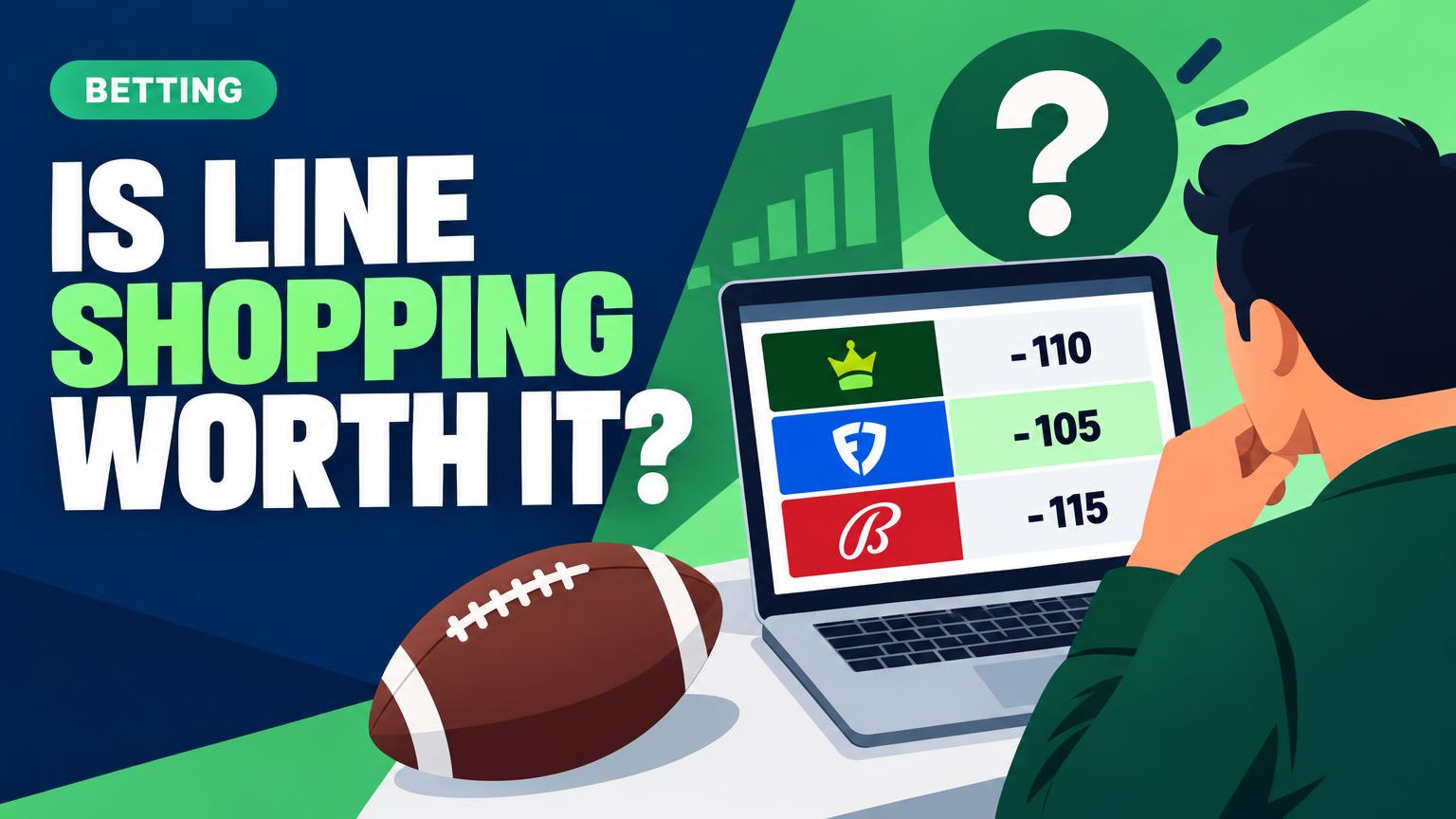
A second sportsbook tab can make a familiar wager a little cheaper.
An NFL point spread is -110 at the sportsbook already open and -105 at another. On a $100 wager, the -105 line pays about $4.33 more if it wins. Understanding how betting odds affect payouts makes that difference easier to judge.
Top Sportsbook Bonuses for November 2026

Golden Panda

TG Casino Sports

MyStake Sports

LuckyBlock Sports

MegaDice Sports

TurboWins Sports

Cosmobet Sports

Rolletto Sports

Velobet Sports

BetAnything
For a recreational bettor, checking one or two funded accounts can be worthwhile, especially when the same bet comes up often. Check that the point spread and game details match; a cheaper price on a different spread is not the same wager. Opening and funding another account for a small, one-time difference may not be worth the trouble. A quick comparison is useful; searching every sportsbook before a modest bet can take the fun out of it.
What five cents means on a $100 bet
Two sportsbooks can offer the same point spread at different prices. For a $100 wager, the payout looks like this:
| Odds | Profit on a win | Total returned on a win |
|---|---|---|
| -110 | About $90.91 | About $190.91 |
| -105 | About $95.24 | About $195.24 |
A losing wager costs $100 at either price. The bettor is not getting a more likely winner or an extra point on the spread—just paying less juice for the same bet.
Suppose a bettor makes 20 separate $100 wagers and wins 10. If each bet had the same outcome at either price, the wins would earn about $909 at -110 or $952 at -105, while the 10 losses would cost $1,000 either way. Both sets of bets would finish in the red, but the better price would reduce the loss by about $43.
That is the practical value of getting -105 instead of -110 over repeated wagers. At those fixed odds, the break-even win rate is about 52.38% at -110 versus 51.22% at -105. Neither price says whether a bettor’s picks will reach that mark.
Checking another sportsbook is worthwhile when the point spread and bet rules match. A lower price on a different spread is not a straight comparison, and a small savings in vig is no reason to force another wager or raise the stake.
Compare the number, not just the juice
A cheaper price is only a better deal when the wager is the same. An NFL favorite at -2.5 (-115) wins if the team wins by three points. At -3 (-105), that same result is a push: the stake is returned, but there is no payout. The lower juice at -3 does not make the two bets interchangeable.
Three is a key number in NFL betting because games can finish with a three-point margin. Seven is another number worth watching. Moving across either can change how often a spread wins, loses or pushes, so a bettor comparing sportsbooks should check the point spread before deciding which price is cheaper. Whether the extra half-point is worth paying for depends on the odds and the matchup.
The same check applies beyond spreads:
- Moneylines: With the same team and game, compare prices directly. A move from -125 to -120 changes the cost, not the outcome needed to win.
- Over/unders: Over 44.5 and over 45 settle differently if the game lands on 45; the latter pushes.
- Props: A player over 69.5 rushing yards is not the same bet as over 70.5, even if one has better juice.
- Parlays: Compare the price only after confirming that every leg, line and settlement rule matches.
A quick line check prevents a small savings in vig from hiding a meaningful change in the wager.
How to shop a line without overthinking it
-
Pin down the exact wager
Note the game, market and selection before comparing prices. A full-game point spread is not the same bet as a first-half spread, and an over/under at 44.5 is not interchangeable with one at 45.5.
-
Check a few available sportsbooks
Compare two or three books where an account is already active. Odds comparison sites can speed up the search, but a quick check of familiar sportsbook apps is enough for many recreational wagers.
-
Compare the line and the juice
Look at the point spread or total first, then the odds. A lower price on a different number may not be a better deal, particularly around common NFL margins.
-
Confirm the bet slip
Open the wager in the sportsbook app and check the current number, odds and stake. For props or less familiar markets, check whether overtime counts and what happens if a player does not participate.
-
Make a decision, then stop
Place the wager only if the available line still fits the original pick and planned bankroll stake. If it has moved too far, passing is a reasonable outcome.
Comparison listings can lag behind live sportsbook odds. A line can also change between opening a market and submitting a wager. The bet slip is the final check; if the price changes, reassess it rather than accepting the new odds automatically.
When the better line isn’t worth the hassle
A slightly better price matters only if the wager is practical to place. A bettor with funds already at one sportsbook may have little reason to deposit at another for a small improvement. Moving money can take time, and spreading a limited bankroll across several apps can leave too little available where the next wager makes sense.
Before adding a sportsbook to the regular rotation, check:
- State access: An account may remain open while betting is unavailable outside states where that book operates. Physical location matters when placing a wager.
- Deposits and withdrawals: Check accepted payment methods, minimums, potential fees and estimated withdrawal times. A convenient deposit method does not necessarily mean an equally convenient payout method.
- App access: Login or geolocation trouble can make a better line unusable, especially when odds are moving.
- Bankroll fit: Judge the difference at the planned stake. Raising the wager just to make a small price advantage feel worthwhile changes the risk.
A bonus bet or odds boost does not change the regular price offered on future wagers. Before counting an offer as an advantage, check its current terms: qualifying deposits or bets, minimum odds, eligible markets, expiry dates and restrictions. An offer that requires extra wagering or ties up funds may be less useful than its headline value suggests.
Is line shopping worth the time?
For most recreational bettors, a quick comparison is worthwhile; an extended search often isn’t. The effort should match how often someone bets, the size of the planned wager and how much the available lines differ.
A bettor placing one small NFL wager on a Sunday may be fine checking two sportsbooks already in use. Opening several more accounts to save a few cents in juice on that single bet can take more time than the difference is worth. Someone making regular wagers, or placing larger stakes within a set bankroll, has more reason to keep a few funded sportsbooks available.
The biggest reason to look beyond a quick price check is a meaningfully different number. If one book has a spread of +3 while another has +2.5, that difference may matter more than a modest change in juice. It is worth confirming that both lines are still available before placing the wager.
A practical stopping rule: check the books that are easy to use, compare the same market, then place the planned bet or pass. A better line improves the terms of a wager; it is not a reason to raise the stake or bet more often.
Keep score on the line shopping itself
A simple log can show whether checking multiple sportsbooks is improving the prices a bettor actually takes. For each wager, record:
- The market, selection, stake and odds taken
- The comparable odds available at another sportsbook when the bet was placed
- The time spent comparing lines
- The closing line at the same spread or total, if available
The comparison needs to be like-for-like. An NFL spread at -105 is not directly comparable to a different point spread at -110, even if both are on the same team. Recording the price available at the time of the wager also avoids mistaking a later market move for a missed opportunity.
After several dozen bets, look for a pattern: how often did shopping find a better price, how much did the typical improvement matter at the stakes used, and how long did it take? A bettor who repeatedly finds only a one-cent difference after ten minutes of searching may decide a quicker check is enough.
Closing line value can help assess price quality, too. If a bet at -105 closes at -115 on the same side and number, the earlier price was better than the market’s final price. That does not mean the bet will win, and one game proves little. It is most useful as a pattern across many wagers, alongside the time log—not as a substitute for it.
Before placing a planned wager, check a few accessible sportsbooks. Take the better price when the bet is equivalent—-105 instead of -110 on the same point spread, for example. If the available line no longer fits the wager, pass.
Line shopping can reduce the cost of a bet, but it cannot make a weak pick worthwhile. It works best alongside a disciplined betting strategy with planned stakes and firm bankroll limits.
Top Sportsbook Bonuses for November 2026
Golden Panda
TG Casino Sports
MyStake Sports
LuckyBlock Sports
MegaDice Sports
TurboWins Sports
Cosmobet Sports
Rolletto Sports
Velobet Sports
