
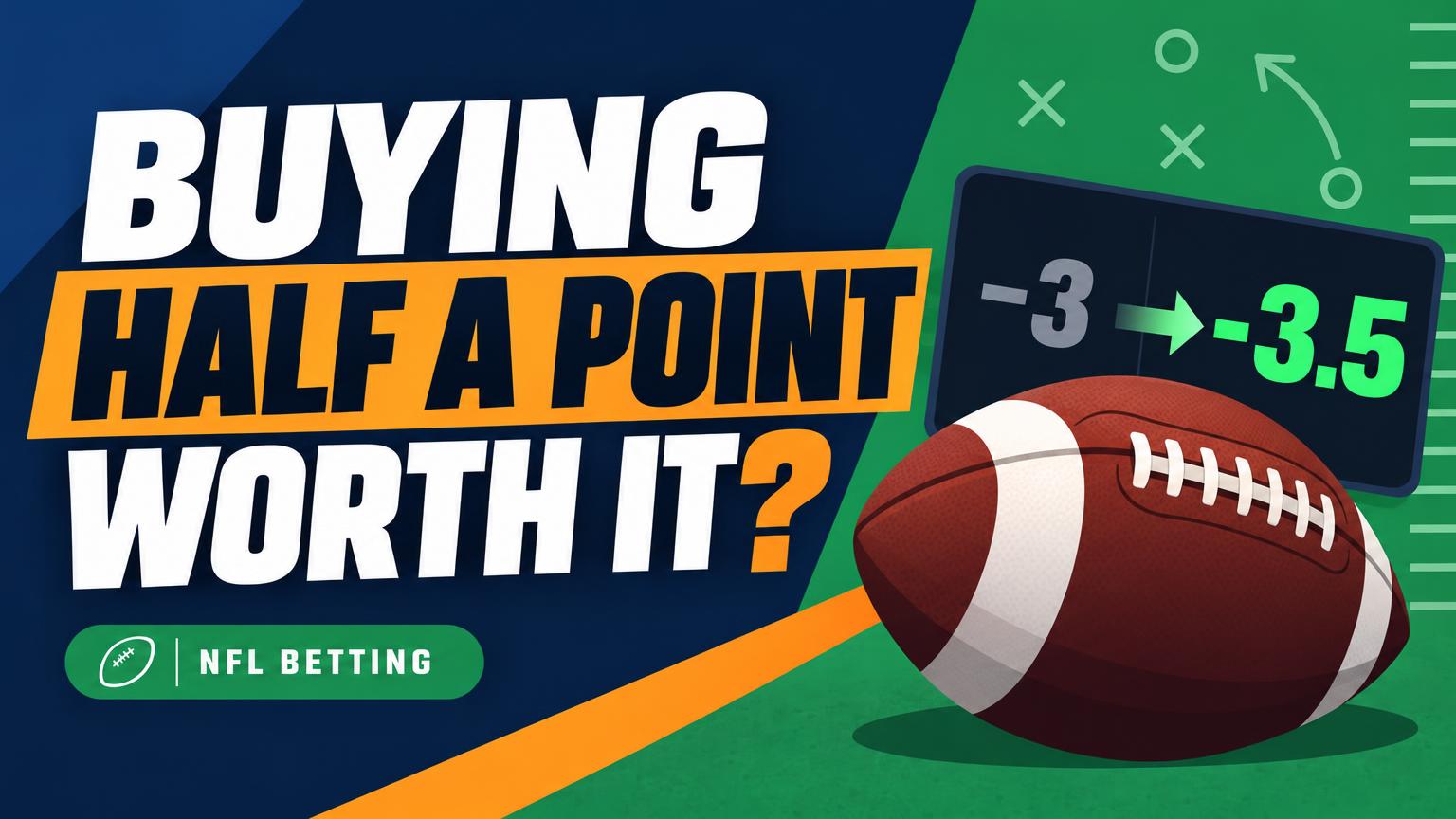
A better spread is only a better bet if the price makes sense.
A bettor likes an NFL favorite at -3.5, then spots -3 at a higher price. If that team wins by exactly three, the original wager loses while the new one pushes. That protection matters—but paying extra juice for it on every bet can eat into a bankroll.
Top Sportsbook Bonuses for November 2026

Golden Panda

TG Casino Sports

MyStake Sports

LuckyBlock Sports

MegaDice Sports

TurboWins Sports

Cosmobet Sports

Rolletto Sports

Velobet Sports

BetAnything
The number crossed and the price paid drive the decision. Three and seven deserve particular attention because NFL games often finish on those margins. Moving across a less consequential number may offer little value, especially at a steep price. Compare the available odds at other sportsbooks before buying a half-point; another book may already offer the preferred spread for less.
What a half-point buy changes
Buying half a point moves the point spread in the bettor’s favor without changing the selected team. A favorite gets a smaller number to cover; an underdog gets a larger cushion. The point spread betting guide covers how those numbers determine a wager’s result.
Consider a favorite initially listed at -3.5. Buying to -3 means a three-point win changes from a loss to a push, with the stake returned. If the starting line is -3, buying to -2.5 makes that same three-point win a winning bet instead of a push. The team and final score are identical; only the purchased line changes the payout.
The direction reverses for an underdog. Buying +2.5 to +3 turns a three-point loss from a losing bet into a push. Buying +3 to +3.5 turns that push into a win. A half-point buy only helps when the final margin lands exactly on the number crossed, so the improved spread has to be weighed against the extra juice the sportsbook charges.
The extra juice is part of the price
Buying a half-point changes two things: the point spread and the odds. The extra juice is not a separate fee paid after the wager. It reduces the profit on a win while the full stake remains at risk on a loss.
| Odds on a $100 wager | Profit if it wins | Break-even win rate* |
|---|---|---|
| -110 | $90.91 | 52.38% |
| -120 | $83.33 | 54.55% |
*Break-even rates count decisive bets—wins and losses—not pushes. A push returns the $100 stake, with no profit or loss.
Suppose a favorite is available at -3.5 (-110), and buying a half-point moves it to -3 (-120). If the team wins by exactly three, the original wager loses while the purchased line pushes. If it wins by four or more, both wagers win, but the -110 bet pays $7.58 more on a $100 stake. The bettor is paying for protection against one specific margin, not improving the payout on every outcome.
A spread already posted at -3 is different from a half-point purchase. Sportsbooks may post different lines and odds on the same game; the half-point in an original line can reflect how the opening spread was set, not an optional add-on. Compare the available spread and its odds before deciding whether paying more juice is worthwhile.
Why 3 and 7 matter more than 5
NFL games often land on margins of 3 or 7 because a field goal is worth three points and a touchdown plus an extra point is worth seven. That makes a half-point move onto either number worth a closer look. It does not make the purchase automatic.
Consider a favorite at -3.5. Buying to -3 turns an exact three-point win from a loss into a push, returning the stake. At -5.5, buying to -5 does the same thing for an exact five-point win. The mechanical benefit is identical, but five is generally a less common NFL margin than three, so the same added juice may be harder to justify.
Seven deserves similar attention: moving from -7.5 to -7 protects against an exact seven-point win. The details of which NFL key numbers matter for half-point buys help explain why the destination matters more than the size of the move.
Before paying for any half-point, compare the sportsbook’s original and adjusted odds. A key number identifies a potentially useful result; the price determines whether protecting against it is worthwhile.
Put a dollar value on the push
Suppose a favorite is available at -3.5 (-110) or -3 (-120), and the bettor stakes $100 either way. Buying the half-point changes the result only when the favorite wins by exactly three, but the higher juice reduces the profit on every win by four or more.
| Final margin | -3.5 at -110 | -3 at -120 |
|---|---|---|
| Favorite wins by exactly 3 | Lose $100 | Push; $100 stake returned |
| Favorite wins by 4 or more | Profit $90.91 | Profit $83.33 |
| Favorite wins by 2 or fewer, or loses | Lose $100 | Lose $100 |
The trade-off is $100 saved on a three-point win versus about $7.58 in profit given up on each win by four or more. Results where both bets lose do not affect the comparison.
To judge the price, a bettor can estimate how often each of the two winning margins will occur. The -3 bet has higher expected value when the chance of a three-point win, multiplied by $100, exceeds the chance of a win by at least four, multiplied by $7.58. For illustration, if the favorite had a 50% chance to win by four or more, a three-point win would need to occur more than about 3.8% of the time for the buy to pay off at these odds.
That threshold is not a prediction for any particular game. It is a way to compare prices: if another sportsbook offers -3 for less juice, the math improves; if it charges more, the push becomes more expensive.
What to check before buying half a point
-
The exact margin
Identify the final margin the new spread covers. Moving an underdog from +6.5 to +7 matters only if it loses by exactly seven points.
Look forA move onto or across a margin worth protecting.AvoidPaying extra for a margin unlikely to matter. -
The outcome it changes
Check whether that margin changes a loss to a push or a push to a win. A favorite moving from -3 to -2.5 turns a three-point win from a refund into a payout.
Look forThe specific settlement before and after the buy.AvoidTreating every half-point move as equally valuable. -
The full price
Compare the original and bought odds, including the extra juice on winning bets. A smaller bankroll may call for a smaller stake, but it does not make an expensive buy a better deal.
Look forBoth quoted prices for the same game and side.AvoidJudging the move by the spread alone. -
Other sportsbooks
Check whether another sportsbook offers the desired spread at lower juice without a buy. Lines and prices vary, so the cheapest route to the same outcome may be elsewhere.
Look forComparable spreads and odds across available books.AvoidPaying for a half-point already offered at a better price.
Compare the line before paying for a half-point
A half-point buy is one way to change a spread, but it should not be the first price a bettor checks. If a sportsbook offers -3.5 at -110 and charges -120 to move to -3, compare these options before placing the wager:
- Keep -3.5: Pay less juice, but lose if the favorite wins by exactly three.
- Buy -3: Pay more juice in exchange for a push on a three-point win.
- Shop for -3: Another sportsbook may post -3 without charging as much. Check the full line and odds, not just the spread.
- Choose an alternate spread: Move farther, perhaps to -2.5, if turning a three-point win into a win rather than a push matters. The odds will typically be shorter, so compare the extra payout protection with its cost.
Buying a point and selecting an alternate spread can produce similar betting lines; the useful distinction is the price offered for the desired outcome. The comparison between bought points and alternate spreads is worth making at the same sportsbook, then checking competing books. Moneylines, parlays, and props answer different betting questions and need not complicate this spread decision.
Check the price before placing the bet
-
Record the standard spread and odds
Start with the line actually available, such as a favorite at -3.5 (-110). That is the baseline for judging the half-point buy.
-
Find the adjusted line and its price
Check whether the sportsbook offers -3 and note the full odds, not just the new spread. At -120, a $100 winning wager profits $83.33; at -110, it profits $90.91.
-
Shop the same spread across sportsbooks
Compare -3 with -3, using the same stake. If another book offers -3 at -115, a $100 win profits $86.96 instead of $83.33 at -120. Both lines push on a three-point win.
-
Check limits and settlement rules
Confirm that the line is available at the intended stake. Sportsbooks can differ on alternate-spread limits and house rules, including how a game postponement affects wagers.
-
Decide before submitting
Review the bet slip for the spread, odds, stake and potential payout. The extra protection may be useful, but it still has to justify the juice.
A promotional wager is not automatically a cheaper way to buy a half-point. Check the sportsbook’s current terms for eligible bets, minimum odds, qualifying requirements, expiry and other restrictions before counting a bonus toward the wager’s value.
A better spread can still be a worse bet if the added juice is too steep.
Compare the price paid with what the half-point actually changes: a loss to a push, or a push to a win.
Landing on 3 or 7 matters, but the sportsbook’s price still decides whether the move is appealing.
A valuable half-point can be overpriced; check the same spread at other sportsbooks before paying for it.
A push returns the stake without profit.
Saving a losing wager is useful, but it should not be counted as winning the bet.
A previous result does not improve the value of the next betting line.
Judge the current spread and odds on their own, rather than paying extra juice to avoid repeating a frustrating finish.
Before buying, identify the exact final margin that changes the bet’s result. Moving a favorite from -3.5 to -3, for example, turns a three-point win from a loss into a push. Then price that protection: at a $100 stake, -120 pays $7.58 less profit than -110 on every winning bet. Check whether another sportsbook offers the same spread for less juice.
If the protection does not justify its cost, keep the standard line or pass. Stay within a preset bankroll limit; buying points is not a guaranteed edge.
Top Sportsbook Bonuses for November 2026
Golden Panda
TG Casino Sports
MyStake Sports
LuckyBlock Sports
MegaDice Sports
TurboWins Sports
Cosmobet Sports
Rolletto Sports
Velobet Sports
