
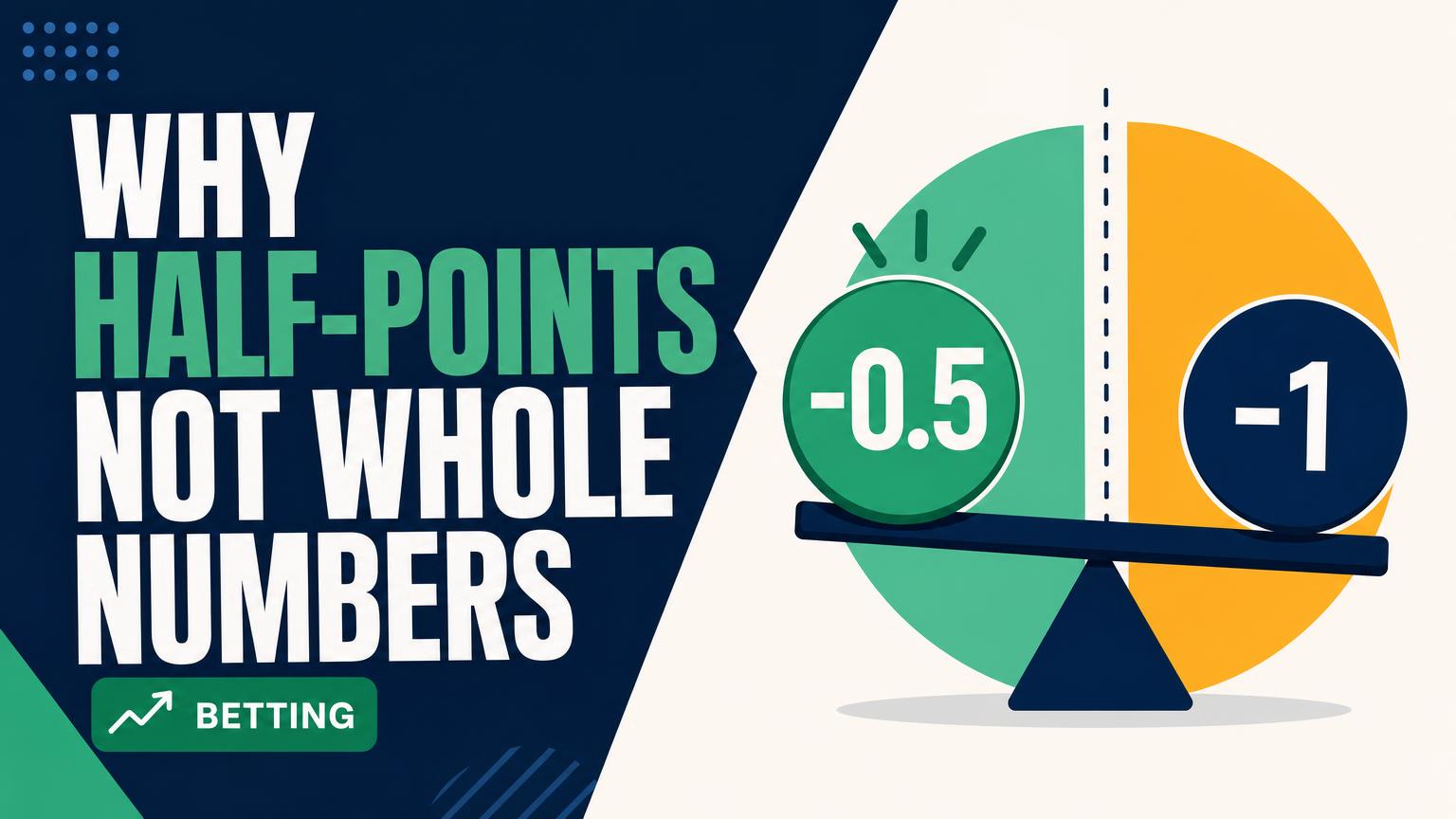
In spread betting, half a point can separate a refund from a losing ticket.
The favorite wins 24–21, exactly as expected. A wager at -3 pushes, so the sportsbook returns the stake. The same wager at -3.5 loses—even though the team won the game and both betting lines looked almost identical before kickoff.
That extra half-point, often called the hook, creates a clear result where a whole-number spread could produce a tie. It can be especially important around common NFL margins such as three points. Sports are scored in whole numbers, but sportsbooks use fractional spreads because the betting market needs more precision than the final scoreboard provides. A line can shift from -3 to -3.5 without predicting half a point on the field; it changes the threshold the favorite must cover.
Why half-points eliminate pushes
A game’s final scoring margin is always a whole number. A team can win by 3, 4 or 10 points, but never by 3.5. That makes the half-point—often called the hook—a simple way for sportsbooks to avoid ties against the spread.
Under the basic mechanics of point spread betting, the favorite gives points while the underdog receives them. The adjusted score determines whether the wager wins or loses.
| Betting line | Final margin | Result for favorite |
|---|---|---|
| Favorite -3 | Wins by 3 | Push |
| Favorite -3.5 | Wins by 3 | Loss |
| Favorite -2.5 | Wins by 3 | Win |
With a whole-number spread, the adjusted score can land exactly even. That produces a push, and the sportsbook normally returns the original stake. A half-point cannot be matched by a whole-number margin, so the wager ordinarily has a clear winner and loser.
The hook does not change which team wins the game. It changes only how the point-spread bet is settled, which is why a move from -3 to -3.5 can materially affect a wager.
How a 24–21 final score is graded
Suppose the favorite beats the underdog 24–21. The favorite won the game, but spread wagers are graded using the three-point winning margin, not either team’s raw score.
| Wager | Adjusted result | Grade |
|---|---|---|
| Favorite -3 | 21–21 | Push |
| Favorite -3.5 | 20.5–21 | Loss |
| Underdog +3 | 24–24 | Push |
| Underdog +3.5 | 24–24.5 | Win |
With favorite -3, subtracting three points from the favorite’s score creates a tie, so the wager pushes and the stake is generally returned. At -3.5, the favorite needed to win by at least four points; a three-point victory does not cover.
The opposite applies to the underdog. +3 produces a push, while +3.5 allows the underdog to lose by three and still cover the spread. That extra half-point is the hook.
What changes with a four-point victory
If the favorite wins 24–20, the winning margin is four points. The favorite covers both -3 and -3.5, while the underdog loses against both +3 and +3.5.
The practical calculation is simple: subtract the losing team’s score from the winning team’s score, then compare that margin with the betting line. A 35–32 game and a 10–7 game are identical for spread grading because both have a three-point margin.
What “Hook” and “No-Push Line” Mean
- Hook
Sportsbook shorthand for the half-point in a spread, such as the 0.5 in -3.5. Buying or losing “the hook” means moving between a whole number and the adjacent half-point.
- No-push line
A spread with a half-point, such as -2.5 or +7.5. Because game scores and winning margins use whole points, the final margin cannot land exactly on the spread.
- Push
A tie between the adjusted score and a whole-number spread. A standard straight wager is generally refunded when the final margin lands exactly on the betting line, though sportsbook rules govern settlement.
- Void wager
A canceled bet caused by a separate rule, such as an abandoned event, ineligible market or listed participant not playing. A void may also return the stake, but it is not a spread-based push.
A whole-number spread can produce a win, loss or push. Adding the hook removes the push from normal spread settlement, leaving a win or loss.
That does not make the half-point automatically favorable. Moving from +3 to +3.5 helps the underdog bettor, while moving from -3 to -3.5 makes the favorite harder to cover. The odds and juice still matter.
Half-points are also pricing tools
A betting market has two pricing levers: the spread and the odds. Moving an NFL favorite from -3 to -3.5 changes the result against the spread when that team wins by exactly three. Moving the price from -110 to -120 leaves the grading threshold unchanged but makes the favorite more expensive to back.
Half-points let sportsbooks adjust that threshold without making a full-point jump. Around an important football number such as three, moving directly from -3 to -4 would materially change the wager. The book can instead add the hook, adjust the juice, or use both:
- Favorite -3 (-120): Higher cost, but a three-point win pushes.
- Favorite -3.5 (-105): Lower cost, but a three-point win loses.
Those lines offer different trade-offs even if they express a similar market view. Adjustments may reflect new information, respected action, or the sportsbook’s exposure. Books manage risk, but they do not necessarily try to balance every market dollar for dollar.
Not every half-point is worth the same
The value of a hook depends on how often a game lands on the neighboring whole number. If a particular victory margin occurs frequently, moving a spread across that number changes the result of more wagers.
In the NFL, 3 and 7 are key numbers because field goals and touchdowns make those margins relatively common. The difference between -2.5 and -3.5 is therefore more meaningful than the difference between -4.5 and -5.5: the first move crosses 3, while the second crosses margins that are generally less prominent.
Consider a favorite winning by exactly three:
- -2.5 covers
- -3 pushes
- -3.5 loses
The same principle applies around 7. A seven-point win covers -6.5, pushes -7 and loses at -7.5. Understanding these key numbers and the half-points around them helps explain why sportsbooks may charge more juice for certain line moves.
Key numbers are not universal, however. Basketball has more scoring events and a wider range of common margins, while soccer’s low scoring makes half-goal lines especially significant. Even within one sport, team style, expected pace, weather and matchup strength can alter the probability distribution.
A hook should therefore be judged by the chance of landing on the adjacent margin, not simply by the fact that it is half a point.
How a sportsbook moves through the hook
-
Opening line: Favorite -3 at -110
A $110 wager would return $100 in profit if the favorite covers. A three-point win produces a push because the spread lands exactly on 3.
-
New information shifts the market
An injury update, confirmed lineup, weather change or respected action may increase demand for the favorite. Movement at other sportsbooks can also prompt an adjustment.
-
First adjustment: Favorite -3 at -120
The book can protect the key number while charging heavier juice. The bettor still gets a push on a three-point win but must risk $120 to win $100.
-
Next move: Favorite -3.5 at -110
If pressure continues, the sportsbook may cross 3 and reset the standard price. Moving the spread can help balance action and reflect a stronger market rating.
-
The new wager carries different risk
At -3.5, a three-point victory loses rather than pushes. That makes -3 at -120 and -3.5 at -110 materially different bets: one costs more, while the other gives up the protection of 3.
Existing wagers are normally settled at the line and odds shown on the accepted ticket.
Who Benefits From the Extra Half-Point?
Which spread is better for the favorite?
Favorites benefit from laying fewer points. A favorite at -3 has more protection than at -3.5 because a three-point win pushes instead of losing.
Which spread is better for the underdog?
Underdogs benefit from receiving more points. Moving from +3 to +3.5 turns a three-point loss from a push into a winning wager.
Does the better spread usually cost more?
Often, yes. A sportsbook may attach heavier juice, such as -120 instead of -110, in exchange for the more favorable number.
Is a posted hook the same as buying a half-point?
No. A posted -3.5 is simply the market’s current betting line; buying from -3.5 to -3 requires accepting adjusted odds under the sportsbook’s rules.
When is buying a half-point worthwhile?
The answer depends on the number crossed, the added vig and the sport. Evaluating whether an extra half-point is worth the price matters most around common winning margins.
A friendlier spread is not automatically a better bet. Compare the original and adjusted odds, then check whether bought points are allowed on parlays, props or promotional wagers.
House rules vary, so confirm pricing, push treatment and settlement restrictions before placing the wager.
How to judge a half-point spread
-
Identify the scoring threshold
Check whether the hook sits beside a key margin, such as 3 or 7 in the NFL.
-
Compare sportsbook lines
Review both the spread and juice. A better number can become a worse wager if its price is too high.
-
Calculate the break-even rate
Standard -110 odds require about 52.4% winners; -120 requires roughly 54.5%.
-
Match the stake to the bankroll
Use a consistent unit size rather than increasing risk because a line appears safer.
-
Confirm settlement rules
Check overtime treatment, void rules and any promotional restrictions before placing the wager.
A hook can prevent a push or turn one side of a key margin into a win. That settlement protection is not automatic value: the spread, odds and stake must be evaluated together.
Disciplined bankroll limits still matter, regardless of how attractive the extra half-point looks.
