
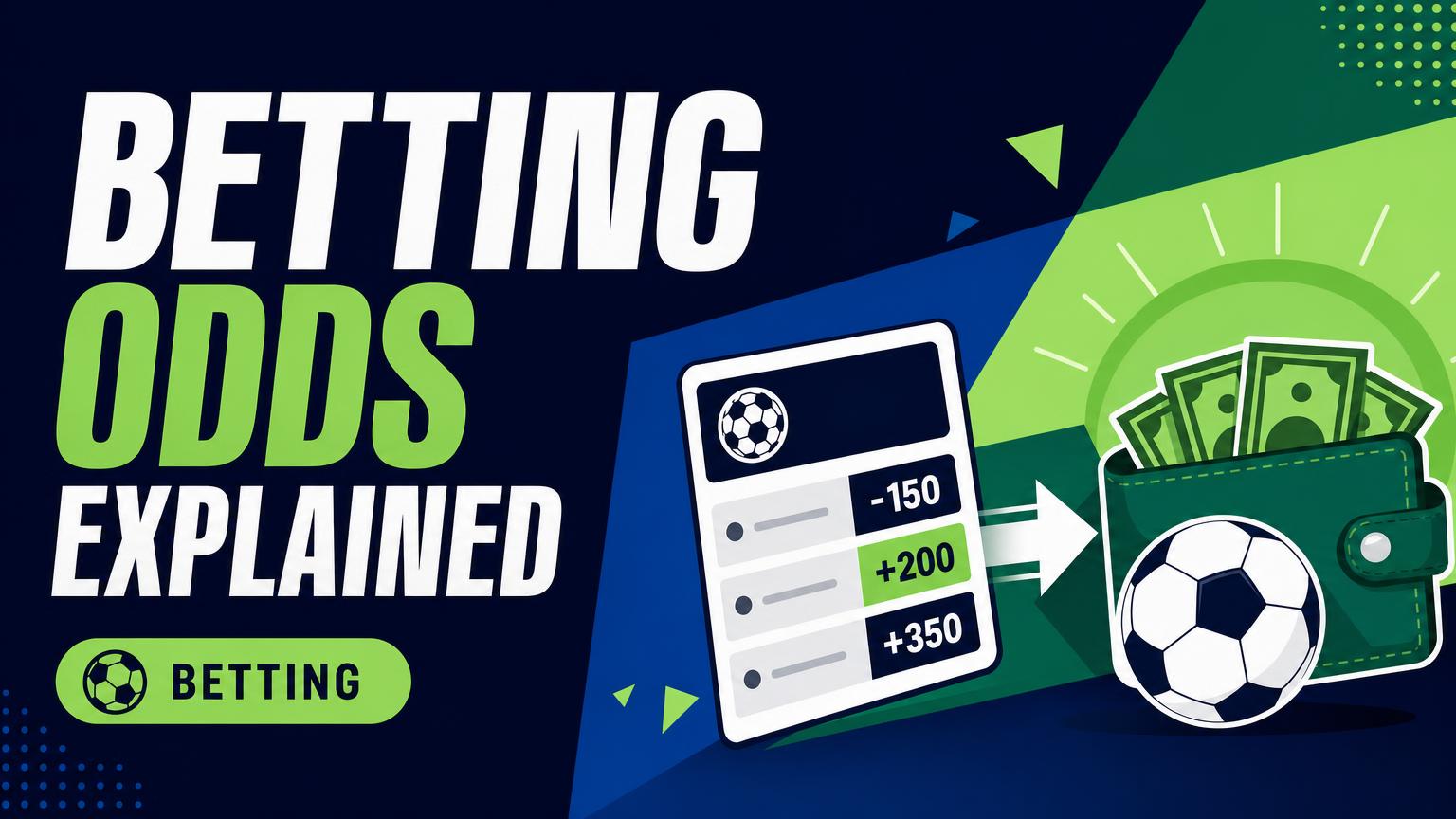
One betting line can contain both the hurdle and the price for taking it.
A line such as Chiefs -3 (-110) puts two different numbers side by side. The -3 point spread is the condition: Kansas City must win by more than three for the wager to cash. The -110 odds are the price: a $110 stake produces $100 in profit, plus the $110 stake returned, for a $210 total payout.
Odds also reflect implied likelihood. At -110, the implied probability is about 52.4%, though that includes the sportsbook’s vig. Positive odds work differently: +150 means a $100 stake earns $150 in profit. The same distinction applies to Over 47.5 (-110)—47.5 is the scoring threshold, while -110 determines risk and payout. On a moneyline, the odds serve as the price because there is no spread or total to beat.
Reading the plus and minus signs
American odds use -100 as the dividing line. Negative odds show how much must be risked to win $100; positive odds show the profit from a $100 wager.
| Odds | What the price means | Break-even probability |
|---|---|---|
| -200 | Risk $200 to profit $100 | 66.67% |
| -110 | Risk $110 to profit $100 | 52.38% |
| +100 | Risk $100 to profit $100 | 50.00% |
| +150 | Risk $100 to profit $150 | 40.00% |
Break-even probability is the win rate needed for the wager to avoid losing money over time at that price, before considering other costs. For negative odds, divide the absolute odds by that number plus 100. For positive odds, divide 100 by the odds plus 100; the full process for calculating implied probability helps when comparing unfamiliar prices.
A sportsbook price is not a guaranteed prediction. It reflects the market, sportsbook adjustments and usually some vig. Bettors with their own estimated win rate can convert probability into betting odds to judge whether the offered line is worthwhile.
For the same selection, a less negative number is better: -105 costs less than -110 for the same $100 profit. The difference between -110 and -105 may look small, but it matters across repeated wagers. Decimal formats express the same pricing another way, and converting American odds to decimal can make return comparisons quicker.
Track the stake from wager to settlement
-
Start with the stake
The stake is the amount risked, not the possible profit. A $50 wager puts $50 of the bankroll at risk.
-
Calculate positive-odds profit
At +150, a $50 winning wager earns $75 in profit: $50 × 1.50. The total return is $125—the $75 profit plus the original $50 stake.
-
Calculate negative-odds profit
At -125, a $100 winning wager earns $80: $100 × (100 ÷ 125). The total return is $180. A step-by-step payout calculation can help check the numbers before placing a wager.
-
Know what a loss costs
If either wager loses, the sportsbook keeps the stake. The profit and total return are both $0, so a $50 losing bet reduces the bankroll by $50.
-
Check how a push is settled
A push usually returns the original stake with no profit. Voids, ties, dead heats and pushed legs in parlays may be handled differently, so settlement follows the sportsbook’s posted house rules.
Potential payout displays often include the returned stake; “to win” figures usually show profit only.
Separate the bet from its price
Every sportsbook listing has two distinct parts: the market and the odds. The market determines what must happen for the wager to win, while the odds determine how much must be risked or how much profit the wager can return.
| Bet type | Winning condition | Attached price |
|---|---|---|
| Moneyline | Team wins the game | Yankees +140 |
| Point spread | Team covers the listed spread | Cowboys -3.5 (-110) |
| Total | Score finishes over or under the number | Over 47.5 (-105) |
| Player prop | Player clears or stays below a statistic | Over 74.5 yards (-115) |
For Cowboys -3.5 at -110, -3.5 is the betting line and -110 is the price. Dallas generally must win by four or more points; the -110 odds mean a $110 stake would produce $100 in profit.
The same distinction applies to live betting, although both pieces can move quickly. A basketball team might shift from +4.5 at -110 to +7.5 at -120 as the score, time remaining and market action change. Bettors should check both numbers before confirming a wager.
A parlay combines multiple winning conditions into one bet. Every leg generally must win, while the combined odds determine the payout. Pushes, voided legs and correlated selections may be handled differently, so sportsbook house rules matter.
A standard two-sided market priced at -110 on both sides implies a 52.38% probability for each outcome. Together, those probabilities total 104.76%, not 100%. That extra 4.76 percentage points is the overround built into the market; the full vig calculation for a two-way line converts it to a theoretical margin of about 4.55%.
If both sides are genuinely equal, each has a 50% no-vig probability, or fair odds of +100. Bettors can remove the margin to estimate fair prices, but those estimates are not objective truth—they only show how the posted probabilities look after normalization.
Vig is a pricing concept; hold is an actual result. A sportsbook’s realized hold depends on where money was wagered, which side won, and the prices accepted. The distinction between sportsbook hold and built-in vig matters because actual revenue will not neatly match the theoretical margin on every game.
At -110, a bettor must win 52.38% of wagers just to break even. Winning exactly 50% means losing $10 for every two $110 bets: one returns $100 profit, while the other loses $110.
Common Questions About Changing Odds
Why do betting lines and prices move?
Sportsbooks react to wagers, injuries, lineup news and market signals; this guide explains what causes betting odds to change. A line can move without public news when respected action or another sportsbook shifts the market.
Are accepted odds locked in?
Usually, the ticket keeps the accepted price even if the market later moves, as covered in how booked odds are handled. Obvious pricing errors, canceled events and house settlement rules can create exceptions.
How do opening and closing lines differ?
The opener is the sportsbook’s initial number; the closer is the final available number before the event starts. Comparing the opening line with the closing line shows how the market changed, not which side will win.
Why is a betting market suspended?
A sportsbook may pause wagering after an injury, scoring play, lineup update or technical issue; suspended-market rules and reopening vary. Markets may return at new odds, while canceled wagers are settled under the sportsbook’s posted rules.
What Line Movement Can—and Cannot—Show
Why line shopping pays
Backing the same side at -110 requires $110 to win $100. At -105, only $105 is needed for the same profit. The selection and outcome are identical; the cheaper price improves the return.
| Price | Stake to win $100 | Break-even rate |
|---|---|---|
| -110 | $110 | 52.38% |
| -105 | $105 | 51.22% |
That five-cent improvement also turns a fixed $110 stake into $104.76 profit instead of $100. Small differences become more significant across repeated wagers, which helps explain whether line shopping is worthwhile for recreational bettors.
Manual checks across several sportsbook apps cost nothing but take time. Odds comparison sites place consensus prices together, making routine checks faster, though free data may refresh less often.
Real-time odds screens are more useful when betting lines move quickly. Price-change alerts reduce constant monitoring by flagging selected markets or thresholds.
For occasional pregame wagers, free tools and a few sportsbook accounts are often sufficient. Paid screens mainly add speed, broader market coverage and customization; this free-versus-paid comparison helps determine whether those advantages justify the cost.
Run this check before betting
-
Confirm the market
Verify the event, selection, line, and whether pricing is live.
-
Price the wager
Calculate the stake, profit, total return, and implied probability.
-
Compare sportsbooks
Check the identical market at licensed books; better lines or lower juice matter.
-
Read settlement terms
Review overtime, pushes, voids, stat corrections, and prop grading.
-
Scrutinize promotions
Confirm opt-in, eligible bets, minimum odds, playthrough, expiry, withdrawal rules, and bonus-credit restrictions.
Promotion terms change; check the sportsbook’s current rules.
Use a fixed bankroll limit for the stake. Every wager can lose, even at a favorable price; record the ticket and never chase losses.
